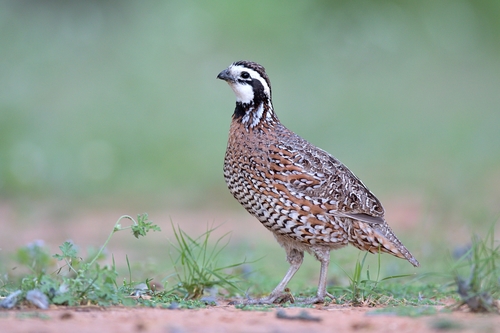
Northern Bobwhite
Colinus virginianus
Meet the 'prince of game birds,' a master of camouflage known for its iconic whistling call and tight-knit social coveys. Discover why this charismatic quail is a favorite of backyard observers and conservationists alike.
Quick Identification
Size
Length: 20-28 cm (8-11 in) | Wingspan: 33-38 cm (13-15 in) | Weight: 140-250 g (5-9 oz)
Colors
Mottled reddish-brown, gray, and black plumage. Males feature a striking white throat and eyebrow stripe bordered by black; females have a similar pattern in buff or cream tones.
Key Features
- Small, chunky round body with a very short tail
- White or buff throat and eye-stripe (male/female)
- Scaly pattern of black, white, and brown on the belly
- Distinctive 'bob-white' whistling call
When You’ll See Them
Geographic range
Where Does the Northern Bobwhite Live?
Native to the North American continent, the Northern Bobwhite's core range extends across the Eastern and Central United States, from the Great Plains to the Atlantic coast and south through Mexico into parts of the Caribbean, including Cuba. While they were historically found as far north as southern Ontario, Canada, they are now most consistently spotted in the Southeast and Midwest. Smaller, introduced populations have also established themselves in parts of Europe, Asia, and even Hawaii, though they remain most synonymous with the American rural landscape.
Basemap © OpenStreetMap contributors
Behavior
Northern Bobwhites are highly social, ground-dwelling birds known for forming 'coveys'—tight-knit groups of 10 to 25 individuals—during the non-breeding season. These coveys often roost in a circle on the ground with their tails pointed inward and heads outward. This 'starburst' formation helps the birds conserve body heat and allows them to monitor for predators from all 360 degrees. When a predator gets too close, the entire group will explode into flight simultaneously in a disorienting 'flush' that provides a split-second window for escape.
They spend the vast majority of their time on the ground, walking or running through dense undergrowth to forage. While they are capable of fast, powerful flight, it is typically reserved for short bursts to reach cover. Humans often hear Bobwhites long before seeing them; the male's clear, ringing 'bob-white!' whistle is one of the most recognizable sounds of the North American countryside during the spring and summer breeding months.
EverydayEarth exclusive
Camera Tips
To capture the Northern Bobwhite on your backyard camera, you must think at ground level. These birds rarely fly unless they are startled, so mounting your camera 6 to 12 inches off the ground is essential. Focus your lens on 'transition zones'—the areas where a mowed lawn meets a brush pile, or where a forest edge meets a field. These birds love micro-corridors and will often follow the exact same path along a fence line or a line of shrubs every single morning.
Baiting is a highly effective way to bring a covey into your camera's field of view. A 'scratch' mix of cracked corn, millet, and sunflower seeds scattered directly on the bare dirt will keep them occupied for several minutes, giving you plenty of footage. Bobwhites are creatures of habit; once they find a reliable food source, they will return at almost the same time every day. Most of your best captures will occur in the two hours following sunrise or the hour just before sunset, as they move between their night roosts and their daytime foraging grounds.
During the winter, look for 'roosting spots'—shallow depressions in the tall grass where a covey has huddled together. Placing a camera near these spots can yield incredible footage of the covey waking up and dispersing. Avoid placing cameras in wide-open, exposed spaces where the birds feel vulnerable to hawks. Instead, tuck your camera into the mouth of a briar patch or under the canopy of a low-hanging evergreen. Use high-speed burst settings if your camera supports them, as the birds' quick pecking and social interactions are best captured in rapid succession.
Similar Species
Species that look similar or are commonly confused with Northern Bobwhite.
Frequently Asked Questions
Record Northern Bobwhite at your habitat
Connect a camera to start building your own species record — AI identifies every visitor automatically.