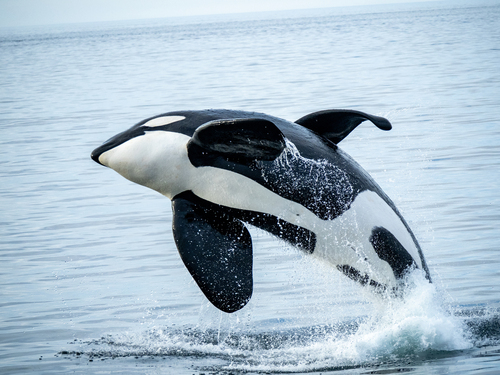
Orca
Orcinus orca
The undisputed masters of the sea, Orcas combine immense power with complex social intelligence. These iconic black-and-white whales are not just predators, but members of deep-rooted families that rule the global oceans.
Quick Identification
Size
Length: 6–8 meters (20–26 feet); Weight: 3,000–6,000 kg (6,600–13,200 lbs)
Colors
Jet-black dorsal side with a brilliant white underside and a distinctive white patch behind each eye; grey 'saddle patch' behind the dorsal fin.
Key Features
- Tall, triangular dorsal fin reaching up to 6 feet in males
- Striking white eye patches positioned just above and behind the eye
- Large, paddle-shaped pectoral flippers
- Robust, streamlined body with high-contrast black and white markings
When You’ll See Them
Sightings on EverydayEarth
Aug 1, 2026
An adult Bald Eagle is perched on a branch of a tree in the foreground, surveying the water. In the background, at least two Orcas are seen surfacing, their dorsal fins appearing briefly above the calm water as they travel through the strait.
Jul 28, 2026
A pod of orcas is observed surfacing and swimming near the rocky shoreline. Several individuals crest the surface, showing their prominent dorsal fins and distinctive white saddle patches as they move through the choppy water.
Jul 28, 2026
Several Orcas are seen swimming through the coastal waters. In the distance, two dorsal fins break the surface together. Later, a single individual passes closer to the camera, surfacing to breathe and showcasing its large dorsal fin and light-colored saddle patch before submerging again.
Jul 27, 2026
A pod of Orcas is observed surfacing and swimming through the choppy waters near a rocky shoreline. The group includes several individuals, with one large male displaying a particularly tall and straight dorsal fin. The whales are maneuvering in the shallows near a known rubbing beach, occasionally rolling and splashing as they move through the area.
Jul 21, 2026
An Orca surfaces briefly in the coastal waters near the shore, showing its prominent dorsal fin and distinctive white saddle patch before submerging again.
Jul 17, 2026
A pod of orcas travels through the open water of the channel. Several individuals are seen surfacing to breathe, with their prominent dorsal fins rising above the water's surface as they move steadily across the frame from right to left.
Geographic range
Where Does the Orca Live?
Orcas are the most widely distributed marine mammals on Earth, successfully inhabiting every ocean from the freezing waters of the Arctic and Antarctic to the warm currents of the equator. While they are truly global citizens, they are most frequently documented in the nutrient-rich coastal waters of the North Pacific, the North Atlantic, and the Southern Ocean. In North America, they are iconic residents of the Pacific Northwest, though significant populations also thrive off the coasts of Norway, Iceland, and New Zealand.
Basemap © OpenStreetMap contributors
Behavior
While they are formidable apex predators, orcas are famously curious and generally non-aggressive toward humans in the wild. They are often observed engaging in 'spyhopping'—lifting their heads vertically out of the water to inspect their surroundings—and breaching, which may serve as a form of communication or simply a way to play.
EverydayEarth exclusive
Camera Tips
Capturing an orca on camera requires a specialized approach, especially for coastal property owners. Mount your AI-powered camera on a stable pier, dock, or high-vantage point overlooking deep-water channels. Because of the extreme contrast between their jet-black skin and brilliant white patches, use a camera with high dynamic range (HDR) capabilities to prevent the white markings from 'blowing out' in bright midday sun.
Angle your camera slightly downward toward the water's surface, ideally with the sun behind the lens to minimize glare and reflection. A high-speed shutter or high-frame-rate video setting is essential for capturing the fast action of a breach or a tail slap. If you are placing a trail camera near the shoreline, ensure it is housed in a saltwater-rated waterproof casing, as even the mist from salt spray can corrode standard equipment over time.
While you cannot attract orcas with traditional bait, you can maximize your success by positioning cameras near natural 'bottlenecks' such as narrow straits, points where currents converge, or known 'rubbing beaches' where orcas are known to groom themselves on smooth pebbles. In regions like the Pacific Northwest, timing your camera deployment with local salmon runs or seal pupping seasons will significantly increase your chances of a sighting.
Similar Species
Species that look similar or are commonly confused with Orca.
Frequently Asked Questions
Record Orca at your habitat
Connect a camera to start building your own species record — AI identifies every visitor automatically.