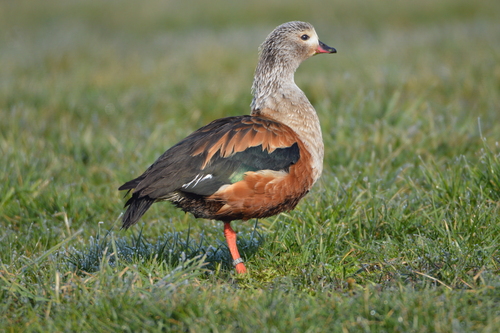
Orinoco Goose
Oressochen jubatus
A regal and rare inhabitant of South American riverbanks, the Orinoco Goose stands out with its buff-colored plumage and vibrant pink legs. Primarily a land-dweller, this unique goose brings a touch of tropical elegance to any wetland camera trap.
Quick Identification
Size
Length: 61–76 cm (24–30 in); Wingspan: 110–135 cm (43–53 in); Weight: 1.2–1.8 kg (2.6–4 lbs)
Colors
Pale buff or cream-colored head and neck; chestnut-brown flanks and breast; dark blackish wings with a broad white speculum and metallic green sheen; bright pink to reddish legs.
Key Features
- Distinctive pale buff head contrasting with reddish-brown body
- Bright pinkish-red legs and feet
- Erect, upright posture more typical of geese than ducks
- White wing patches clearly visible during flight
When You’ll See Them
Behavior
The Orinoco Goose is a surprisingly terrestrial bird that spends a significant amount of its time walking and grazing on land rather than swimming. Unlike many other waterfowl, it is rarely found in open water, preferring the muddy banks of tropical rivers and the edges of forested wetlands. They are known for being highly territorial, especially during the breeding season, when pairs will aggressively defend their nesting sites from intruders with loud, honking displays.
These geese have a unique social structure, often seen in pairs or small family groups. They are vocal birds; males produce a high-pitched whistle while females have a more traditional, raucous honk. Interestingly, they are cavity nesters, often seeking out large hollows in old-growth trees near water sources to raise their young, a behavior that sets them apart from many ground-nesting waterfowl in South America.
EverydayEarth exclusive
Camera Tips
To capture the Orinoco Goose on a trail camera, you must focus on the 'transition zones' where the forest meets the water. These birds are creatures of habit and will often use the same flat, muddy banks to exit the water and begin grazing. Look for their distinct three-toed webbed tracks in the mud to identify high-traffic areas. Position your camera low to the ground—about 12 to 15 inches high—to capture their striking pink legs and the intricate feather patterns of their buff-colored necks.
If you are monitoring a backyard or ranch area, place your camera near a low-profile water trough or a consistent puddle. Orinoco Geese are quite wary of movement, so an AI-powered camera that can trigger silently is a major advantage. Set your camera to a multi-shot burst mode (3-5 photos per trigger). These birds have a beautiful wing-spreading display when they feel territorial or are preparing for flight, and a single shot often misses the brilliant white and green patches on their wings.
Time of day is critical; they are most active during the 'golden hours' of dawn and dusk. Ensure your camera is positioned so the rising or setting sun doesn't blow out the pale colors of their heads. In regions with a distinct dry season, cameras should be moved to the last remaining water holes, as these geese will travel significant distances to find moisture and will become much more predictable in their movements as water becomes scarce.
Similar Species
Species that look similar or are commonly confused with Orinoco Goose.
Frequently Asked Questions
Record Orinoco Goose at your habitat
Connect a camera to start building your own species record — AI identifies every visitor automatically.