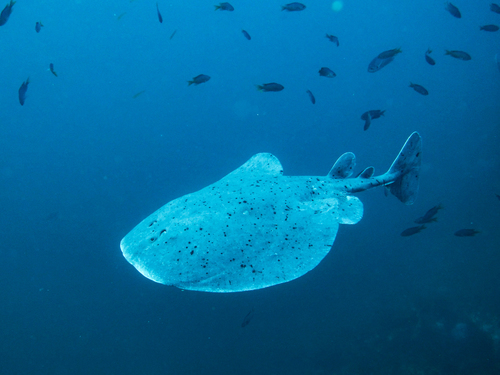
Pacific Electric Ray
Tetronarce californica
The Pacific Electric Ray is the ocean's silent powerhouse, a master of ambush that uses bio-electricity to stun its prey. Found gliding through kelp forests and sandy flats, this fascinating ray is a true marvel of marine evolution.
Quick Identification
Size
Typically 0.6–1 m (2–3.3 ft), with large females reaching 1.4 m (4.6 ft); can weigh up to 41 kg (90 lbs).
Colors
Dorsal surface is uniform dark gray, slate, or leaden brown; often features small, dark, scattered spots; the underside is creamy white.
Key Features
- Circular pectoral fin disc that is broader than it is long
- Two unequal dorsal fins located on a thick, muscular tail
- Visible kidney-shaped electric organs on either side of the head
- Smooth-rimmed spiracles (breathing holes) located behind the eyes
When You’ll See Them
Sightings on EverydayEarth
Mar 29, 2026
A Pacific Electric Ray glides gracefully over the sandy ocean floor, passing close to a rocky ledge covered in marine growth. The camera then shifts to show a school of small fish darting between the towering columns of an amber-colored kelp forest.
Mar 27, 2026
A Pacific Electric Ray glides gracefully over the sandy ocean floor before swimming toward a rocky outcropping covered in marine growth.
Mar 24, 2026
A Pacific Electric Ray swims slowly across the sandy seafloor near a rocky ledge. The scene then transitions to a dense kelp forest where several fish, including a California Sheephead and schools of smaller fish, swim through the amber-colored blades.
Mar 18, 2026
A Pacific Electric Ray glides gracefully just above the sandy floor of the kelp forest. It moves with slow, undulating motions of its pectoral fins, eventually swimming behind a large kelp holdfast and out of the immediate foreground. Smaller, out-of-focus fish are briefly visible in the background.
Mar 17, 2026
A Pacific Electric Ray glides over the sandy seabed, its rounded body and thick tail clearly visible against the green-tinted water of the kelp forest environment.
Mar 16, 2026
A Pacific electric ray is seen swimming slowly over a sandy substrate within a kelp forest environment.
Behavior
The Pacific Electric Ray is a solitary and somewhat sluggish predator during the day, often found resting partially buried in the sand or mud. They are famous for their specialized electric organs, derived from muscle tissue, which can discharge a powerful shock of up to 45 volts. They use this bio-electricity primarily to stun fast-moving prey and to deter potential predators like sharks or sea lions.
Unlike many other ray species that remain strictly on the seafloor, the Pacific Electric Ray is a surprisingly active swimmer. At night, they frequently leave the bottom to cruise through the water column, sometimes hundreds of feet above the floor. While generally indifferent to humans, they are known to be curious and may approach divers. They should be treated with caution, as a shock can be strong enough to temporarily disable a person.
EverydayEarth exclusive
Camera Tips
To capture high-quality footage of a Pacific Electric Ray, you will need a waterproof action camera or a specialized underwater housing. Focus your efforts on 'edge' habitats—the areas where a rocky reef or kelp forest transitions into a sandy flat. These rays love to bury themselves in the sand just outside the cover of the reef to ambush prey drifting by. Look for a 'footprint' in the sand—a faint, circular depression that indicates a ray is buried just beneath the surface.
Placement is critical: secure your camera to a weighted sand-plate or a low-profile tripod no more than 6 to 12 inches off the seafloor. Angle the lens slightly upward to catch the ray's silhouette if it swims overhead, or parallel to the sand to capture the undulation of its thick tail as it glides along the bottom. Because these rays are most active in total darkness, you must use artificial lighting. We highly recommend using red-filtered LED lights; rays and most fish have poor sensitivity to red light, whereas bright white lights may cause them to flee the area immediately.
Motion triggers are notoriously difficult to use underwater due to floating kelp and surge movement. Instead, set your camera to a 'Time Lapse' or 'Interval' video mode, capturing a 10-second clip every two minutes. This ensures you catch the ray even if its movement is too slow to trigger a sensor. If your camera allows for high frame rates (60fps or higher), use it; slowing down the footage can help you see the subtle 'pulse' of the ray when it discharges electricity or the incredible speed of its strike when it moves from a buried position to engulfing a fish.
Similar Species
Species that look similar or are commonly confused with Pacific Electric Ray.
Frequently Asked Questions
Record Pacific Electric Ray at your habitat
Connect a camera to start building your own species record — AI identifies every visitor automatically.