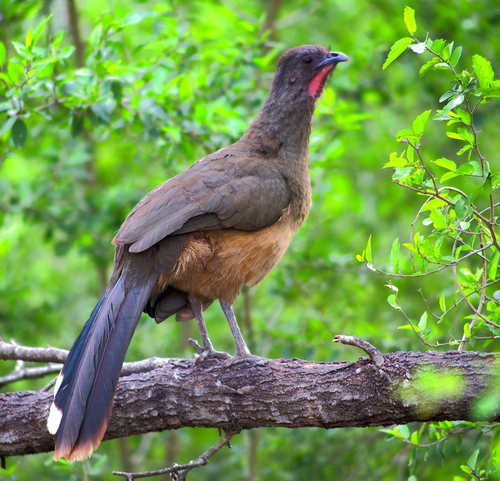
Plain Chachalaca
Ortalis vetula
The Plain Chachalaca is the tropical 'loudmouth' of the Rio Grande Valley. Known for its raucous morning choruses and chicken-like appearance, this social bird brings a unique jungle energy to South Texas backyards.
Quick Identification
Size
Length: 48–58 cm (19–23 in); Wingspan: 58–66 cm (23–26 in); Weight: 310–770 g (11–27 oz)
Colors
Dull olive-brown upperparts and wings with a paler, buff-colored underbelly; dark greenish-black tail with pale tips; bare red throat skin visible on males during breeding season.
Key Features
- Long, rounded tail with buffy-white or gray tips
- Small, chicken-like head and short, curved bill
- Overall drab olive-brown plumage lacking bright colors
- Social groups frequently seen in brushy undergrowth
When You’ll See Them
Behavior
Plain Chachalacas are highly social birds that are almost always found in small family groups or larger flocks of up to 15 individuals. They are famously vocal, especially at dawn and dusk, when they engage in a loud, rhythmic chorus that sounds like 'cha-cha-lac-a.' This call is often a duet between pairs or a group-wide performance that can be heard from a significant distance.
While they are shaped like small turkeys or chickens, they are remarkably agile in the trees. They prefer to move through dense canopy or thickets by leaping from branch to branch rather than flying long distances. On the ground, they walk with a deliberate, high-stepping gait, often scratching at leaf litter to uncover food.
In suburban areas of the Rio Grande Valley, they have become quite accustomed to humans. They frequently visit backyard bird feeders and water stations, showing a level of boldness that makes them a favorite for backyard observers, though their loud morning wake-up calls are legendary among residents.
EverydayEarth exclusive
Camera Tips
To capture the best footage of Plain Chachalacas, place your camera near native fruiting trees or dense shrubs like Texas Ebony or Wild Olive. These birds are arboreal by nature but will descend to the ground for fallen fruit or water. Mounting your camera at a height of 3 to 5 feet, angled slightly downward toward a clearing in the brush, is ideal for catching them as they move between the canopy and the ground.
Water is a massive draw for this species, especially in the arid environments of South Texas. A low-profile bird bath or a ground-level drip system will guarantee frequent visits. Set your camera to 'Burst Mode' or short video clips (15-20 seconds); Chachalacas are rarely still, and video is the best way to capture their unique tail-flicking displays and social interactions within the flock.
Since they travel in groups, use a wide-angle lens setting if your camera allows it. This prevents 'frame-crowding' where one bird blocks the view of the others. If you are using a triggered camera, set the sensitivity to medium-high; despite their size, their movements through thickets can be subtle until they reach an open patch.
Early morning is the peak time for their famous vocalizations. If your camera has a high-quality microphone, ensure it is enabled to capture the 'cha-cha-laca' chorus. During the breeding season (March through August), look for the males' bright red throat patches, which become much more prominent during their displays. Position the camera facing away from the direct morning sun to avoid silhouetting these drab-colored birds against a bright background.
Similar Species
Species that look similar or are commonly confused with Plain Chachalaca.
Frequently Asked Questions
Record Plain Chachalaca at your habitat
Connect a camera to start building your own species record — AI identifies every visitor automatically.