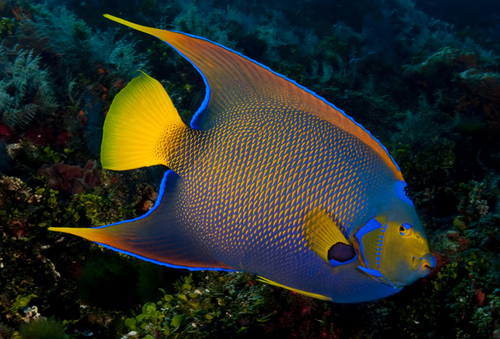
Queen Angelfish
Holacanthus ciliaris
Widely regarded as the most stunning fish in the Atlantic, the Queen Angelfish is a master of the coral reef. With its glowing blue 'crown' and electric yellow fins, this royal resident is the ultimate prize for any underwater camera enthusiast.
Quick Identification
Size
Typically 30–45 cm (12–18 inches) in length; weight averages around 1.1–1.6 kg (2.5–3.5 lbs)
Colors
Brilliant turquoise-blue and lemon-yellow body; fins are edged in electric blue; the namesake 'crown' is a black orb ringed in bright blue on the forehead.
Key Features
- Distinct blue-ringed 'crown' on the forehead
- Vibrant, solid yellow tail fin
- Deeply compressed, disc-like body shape
- Electric blue trim on the trailing edges of the dorsal and anal fins
When You’ll See Them
Sightings on EverydayEarth
Jul 30, 2026
A vibrant coral reef scene featuring a large Queen Angelfish swimming across the lower foreground. The water is teeming with life; several bright blue Chromis hover in the water column while Bicolor Damselfish and juvenile Bluehead Wrasse move amongst the large sea fans and brain corals. The reef is active with various species navigating the surge-swept gorgonians under bright sunlight.
Behavior
The Queen Angelfish is widely considered one of the most beautiful inhabitants of the Atlantic reefs. These fish move with a graceful, fluttering motion, using their thin bodies to navigate through tight coral crevices. While they are occasionally solitary, they are frequently seen in long-term pairs, suggesting a monogamous social structure that is relatively rare among reef fish.
Despite their royal name, they are quite curious and bold. They spend their daylight hours patrolling a home range, foraging for food and occasionally visiting 'cleaning stations' where smaller fish or shrimp remove parasites from their scales. They are not aggressive toward humans but are territorial toward other angelfish, often engaging in subtle displays of dominance to protect their favorite feeding spots.
EverydayEarth exclusive
Camera Tips
To capture high-quality footage of a Queen Angelfish, placement is everything. These fish are creatures of habit and often follow the same 'patrol routes' through the reef every day. Look for areas with high concentrations of colorful sponges—their primary food source—and mount your camera nearby. Positioning the lens at a slightly upward angle from a lower reef shelf will help capture the iridescent blue of their scales as they catch the sunlight filtering down from the surface.
Lighting is your biggest challenge underwater, as water filters out red and yellow wavelengths first. To truly capture the 'royal' yellow and blue of this species, use a camera with a high-quality red filter or provide external underwater LED lighting. Queen Angelfish are curious and will often swim directly up to a stationary camera to inspect their reflection in the lens, providing excellent close-up opportunities.
If you are using an AI-powered underwater housing, set your trigger sensitivity to medium. Because angelfish move with a rhythmic, fluttering motion, slow shutter speeds can cause motion blur; aim for at least 1/120s if your settings allow. Since they are most active during the brightest parts of the day, 10:00 AM to 2:00 PM is the golden window for capturing the full spectrum of their coloration without needing heavy artificial light.
Avoid placing cameras in high-surge areas where bubbles or debris might trigger the sensor unnecessarily. Instead, look for 'cleaning stations'—patches of reef where small gobies or cleaner shrimp live. The Queen Angelfish will often hover perfectly still at these locations for several minutes, allowing for long, stable, and incredibly detailed captures of their intricate patterns and 'crown' markings.
Similar Species
Species that look similar or are commonly confused with Queen Angelfish.
Frequently Asked Questions
Record Queen Angelfish at your habitat
Connect a camera to start building your own species record — AI identifies every visitor automatically.