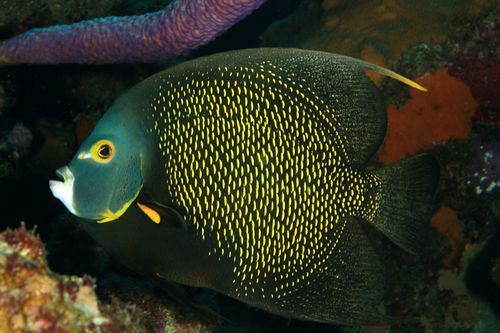
French Angelfish
Pomacanthus paru
A golden-rimmed icon of the Caribbean, the French Angelfish is famous for its lifelong pair-bonds and curious, friendly personality on the reef.
Quick Identification
Size
Length up to 41 cm (16 inches); weight typically between 1-2 kg (2-4.5 lbs)
Colors
Adults are black with scales rimmed in bright yellow; juveniles are jet black with five vertical yellow bands
Key Features
- Disc-shaped, laterally compressed body
- Yellow-rimmed scales on a dark background
- Bright yellow ring around the eye
- Elongated filaments on dorsal and anal fins
When You’ll See Them
Sightings on EverydayEarth
Jul 3, 2026
A vibrant coral reef scene is bustling with life. Schools of small, bright blue Chromis hover in the water column, while several yellow Bluehead Wrasse dart among the reef structures. A French Angelfish slowly swims across the scene behind the waving purple sea fans, which sway in the gentle current.
Jun 8, 2026
A vibrant reef scene with several small, bright yellow Bluehead Wrasse swimming actively among the swaying sea fans. A French Angelfish glides through the center of the frame, showing its distinctive yellow-rimmed scales. An Atlantic Blue Tang is also briefly visible moving in the background through the clear blue water.
Apr 16, 2026
A bustling scene on a tropical reef wall. Several Bluehead Wrasses in both their bright yellow juvenile phase and blue-headed terminal phase dart between the swaying sea fans and soft corals. A few Sergeant Majors drift calmly in the current above the reef, while a large French Angelfish moves gracefully through the shadows of the reef structure in the background.
Apr 15, 2026
A vibrant reef scene features a large purple sea fan as the centerpiece. A French Angelfish swims near the right edge of the fan before moving behind it. Several Caribbean Bluehead Wrasse, including both terminal phase individuals with blue heads and yellow initial phase individuals, dart quickly between the corals and through the water column.
Apr 15, 2026
A vibrant reef scene filled with activity. A large French Angelfish swims into the foreground, grazing near the coral. Several Sergeant Majors and schools of yellow Bluehead Wrasses dart around large sea fans and brain corals as the current gently sways the vegetation.
Mar 30, 2026
A busy reef scene on a steep wall. Initially, two large Permit swim across the upper frame. A French Angelfish then approaches and investigates the camera lens closely, showing its intricate scale patterns. A yellow-phase Bluehead Wrasse darts through the foreground. Finally, a large shark swims past the camera, opening its mouth wide in a gape toward the lens.
Geographic range
Where Does the French Angelfish Live?
Native to the warm, tropical waters of the Atlantic Ocean, the French Angelfish is a staple of the Caribbean marine ecosystem. Its primary range extends from the Florida Keys and the Bahamas through the Gulf of Mexico, reaching as far south as the coast of Brazil. In the Eastern Atlantic, isolated populations are also found near Ascension Island and the Saint Paul's Rocks. They thrive in clear, shallow waters where coral growth is dense, providing both food and shelter.
Basemap © OpenStreetMap contributors
Recorded on EverydayEarth
Behavior
French Angelfish are well-known for their highly social and monogamous nature. They are almost always seen in pairs, swimming gracefully together as they forage across the reef. These pairs are strongly territorial and will work together to defend their home range against intruders, especially other angelfish. They are diurnal, meaning they are active during the day and retreat into the safety of reef crevices as the sun sets to avoid nocturnal predators.
Juveniles exhibit a fascinating behavior known as 'cleaning.' They set up cleaning stations where they signal to larger fish—such as jacks, snappers, and even moray eels—to stop and allow the juvenile angelfish to pick off external parasites and loose skin. This mutualistic relationship provides the young fish with a steady food source while offering a valuable health service to the reef community.
As adults, French Angelfish are remarkably curious and show little fear of humans. They are known to approach divers and snorkelers, often following them at a distance. This inquisitive nature makes them one of the most photographed and recognized fish in the Caribbean, though they will quickly retreat if they feel threatened.
EverydayEarth exclusive
Camera Tips
To successfully capture the French Angelfish on an underwater camera, focus on the 'topography' of the reef. These fish love vertical structures and ledges where sponges grow abundantly. Place your camera near a large coral head or a rocky overhang at a depth of 5 to 15 meters. Because they are territorial, if you see a pair once, they are likely to pass that same spot several times throughout the day. Mounting the camera on a stable tripod or weighted base is essential to prevent tide-induced motion blur.
Lighting is your biggest challenge underwater. For the best results, set your camera to record during peak daylight hours (10 AM to 2 PM) when the sun is directly overhead. This natural light highlights the striking contrast between their black bodies and yellow-rimmed scales. If your camera setup allows for external lights, use a wide-beam 'video light' to bring out the vibrant colors that are often lost at depth, but be careful not to place it too close to the lens to avoid backscatter from floating particles.
If you are using a motion-triggered camera, ensure the sensitivity is set high, as the swaying of seagrass or fans can sometimes mask the graceful movement of a fish. Alternatively, a time-lapse mode set to capture an image every 30 to 60 seconds is often more effective for reef monitoring. This method is particularly useful for documenting the interaction between juveniles and the larger fish that visit their cleaning stations.
For those with backyard docks or seawalls in tropical areas, look for vertical growth of barnacles or algae. Juveniles frequent these shallower, protected zones. Aim your camera toward a sheltered nook; you might catch the 'cleaning dance' where the juvenile moves in a fluttering motion to attract 'clients.' Keep your lens clean—saltwater buildup and algae can quickly obscure your view, so a weekly wipe-down with a soft cloth is recommended.
Similar Species
Species that look similar or are commonly confused with French Angelfish.
Frequently Asked Questions
Record French Angelfish at your habitat
Connect a camera to start building your own species record — AI identifies every visitor automatically.