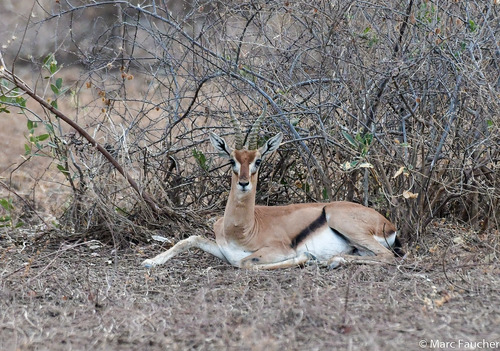
Red-fronted Gazelle
Eudorcas rufifrons
A resilient icon of the African Sahel, the Red-fronted Gazelle is a master of camouflage in the arid scrublands. With its striking rufous coat and elegant, ringed horns, it remains one of the region's most graceful and sought-after sightings for wildlife enthusiasts.
Quick Identification
Size
Shoulder height: 60–70 cm (24–28 in); Weight: 25–30 kg (55–66 lbs)
Colors
Sandy-red or rufous-brown upper body, white underparts, and a distinct but narrow black stripe along the flanks. The face features white eye-rings and a bright reddish forehead.
Key Features
- Distinct reddish-brown forehead and nose bridge
- Thin black horizontal stripe on the flank
- Small, ringed, S-shaped horns present in both sexes
- White eye-rings with dark 'tear' streaks running to the mouth
When You’ll See Them
Behavior
Red-fronted Gazelles are social but tend to live in smaller, more intimate groups than many other African bovids. They are typically seen in pairs or small family units of up to ten individuals. They are relatively shy and prefer the security of light woodland or shrubby steppes over wide-open plains, often blending into the tall grasses of the Sahel to avoid detection by predators like leopards and cheetahs.
These gazelles are highly mobile and exhibit nomadic tendencies, following the rains to find the freshest grazing patches. While they are naturally wary of human presence, they are increasingly found on the periphery of agricultural lands, where they may occasionally forage on crops or utilize man-made water sources during the harsh dry season. Their social structure is loose, and they do not form the massive migratory herds seen in species like the wildebeest.
EverydayEarth exclusive
Camera Tips
Capturing the Red-fronted Gazelle requires a strategic approach to camera height and placement. Because these animals are medium-sized and tend to keep their heads low while grazing, mount your camera approximately 24 to 30 inches off the ground. This height ensures you capture the critical identification markers, such as the thin black flank stripe and the unique facial patterns, without the perspective being distorted by looking down from a high tree mount.
Since this species is crepuscular, your camera's performance in low-light conditions is paramount. Use a camera with a high-quality infrared sensor and a fast trigger speed—ideally under 0.4 seconds. These gazelles are nimble and often pause only briefly; a slow trigger will result in 'empty' frames or blurry tails. Set your camera to 'Burst Mode' to take 3–5 photos per trigger, which increases the likelihood of getting a clear shot of the horns, which are essential for determining the sex of the individual.
Location is key in the arid Sahel environment. Look for 'natural funnels'—gaps in thorny acacia scrub or well-trodden paths leading toward seasonal ponds (wadis). During the peak of the dry season, placing your camera near a water source is almost a guaranteed way to see them. However, avoid placing the camera in direct sunlight; the heat can cause 'false triggers' and the harsh glare can wash out the subtle reddish tones of their coat. Aim for a north-facing orientation to ensure consistent lighting throughout the day.
If you are monitoring a large area, consider using a camera with a wide-detection zone. Red-fronted Gazelles are often more solitary or travel in small groups, so they don't create the heavy, obvious trails that larger game might. Look for their small, heart-shaped tracks in sandy soil as a guide for placement. Finally, ensure your batteries are fresh and consider a solar panel attachment, as the intense African sun can be leveraged to keep your camera running for months without maintenance.
Similar Species
Species that look similar or are commonly confused with Red-fronted Gazelle.
Thomson's Gazelle
Features a much bolder and wider black flank stripe and a less reddish face.
Grant's Gazelle
Significantly larger with much longer horns and a white patch that extends above the tail onto the rump.
Dorcas Gazelle
Smaller and much paler in color, lacking the distinct dark flank stripe of the Red-fronted Gazelle.
Frequently Asked Questions
Record Red-fronted Gazelle at your habitat
Connect a camera to start building your own species record — AI identifies every visitor automatically.