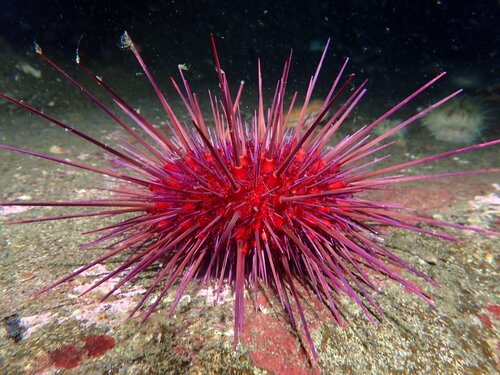
Red Sea Urchin
Mesocentrotus franciscanus
A crimson icon of the Pacific coast, the Red Sea Urchin is a long-lived marvel that turns the rocky seafloor into a vibrant underwater garden.
Quick Identification
Size
Test (shell) diameter up to 19 cm (7.5 in); spines can add an additional 5-8 cm (2-3 in) in length
Colors
Uniform deep red, reddish-pink, or dark burgundy; spines are the same color as the body
Key Features
- Large spherical body covered in long, sharp, mobile spines
- Bright red to dark purple-red coloration
- Found primarily on rocky substrates in low-tide zones
- Five-toothed mouth (Aristotle's lantern) located on the underside
When You’ll See Them
Sightings on EverydayEarth
Mar 31, 2026
A bright orange Garibaldi swims through a rocky underwater environment, moving towards and then away from the camera. The seafloor is populated with numerous purple and red sea urchins nestled among various species of red and green algae. A Kelp Bass is briefly seen swimming past in the background.
Behavior
Red Sea Urchins are the patient gardeners of the Pacific rocky reefs. While they might look like static pincushions, they are surprisingly active grazers, using their five-toothed mouthparts—known as an 'Aristotle's lantern'—to scrape algae and kelp from rocks. They move slowly across the seafloor using a combination of their mobile spines and hundreds of tiny, suction-tipped tube feet. Interestingly, they often use these tube feet to hold shells or pebbles over their bodies as a sort of 'sunscreen' or camouflage against predators.
These invertebrates are remarkably long-lived, with some individuals estimated to be over 200 years old. In a healthy ecosystem, they play a vital role in cycling nutrients, but if their natural predators like sea otters are absent, their populations can explode, leading to 'urchin barrens' where they consume entire kelp forests. For humans, they are mostly encountered by tide-poolers or divers, and they are highly prized in culinary circles for their 'uni' (gonads).
EverydayEarth exclusive
Camera Tips
Capturing the Red Sea Urchin on camera requires a specialized approach since they are entirely aquatic. If you have a 'backyard' that borders a rocky Pacific shoreline, your best bet is a waterproof action camera or a trail camera inside a dedicated underwater housing. Because urchins move at a literal snail's pace, traditional motion-triggering (PIR) often fails underwater. Instead, set your camera to 'Time-Lapse' mode. A photo taken every 30 to 60 seconds over several hours will reveal their slow-motion migration and feeding habits that are invisible to the naked eye.
Placement is key. During low tide, look for deep, permanent tide pools or crevices in the rocks. Secure your camera housing using a weighted base or a heavy-duty clamp to ensure wave action doesn't sweep your gear into the deep. Aim the lens toward a patch of kelp or a rocky ledge where you see several urchins clustered. If you are filming in deeper water, remember that red light is the first color to disappear as you go deeper; using an external underwater light will bring out those brilliant crimson hues that make this species so striking.
Pay attention to the tides. The best footage is often captured as the tide is coming in, as the influx of fresh, oxygenated water and drifting kelp triggers higher activity levels in the urchins. If you are using a camera with a macro lens, try to get a close-up of the tube feet or the 'Aristotle’s lantern' on the underside—it’s a fascinating look at biological engineering. Just be sure to rinse all your equipment in fresh water after use to prevent salt corrosion.
Similar Species
Species that look similar or are commonly confused with Red Sea Urchin.
Frequently Asked Questions
Record Red Sea Urchin at your habitat
Connect a camera to start building your own species record — AI identifies every visitor automatically.