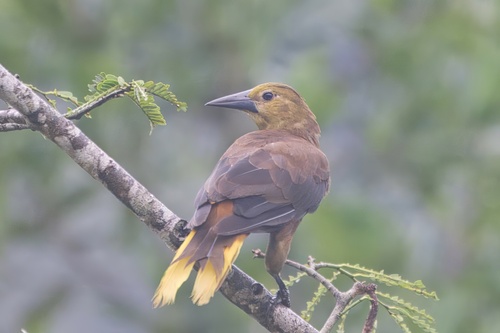
Russet-backed Oropendola
Psarocolius angustifrons
A master of the canopy, the Russet-backed Oropendola is famous for its elaborate hanging nests and prehistoric-sounding calls. With its striking yellow tail flashes and social personality, it is one of the most rewarding birds to capture on a backyard trail camera.
Quick Identification
Size
Length: 35-48 cm (14-19 in); Weight: 175-450g (6-16 oz), with males being significantly larger than females.
Colors
Mainly olive-green and deep brown (russet) plumage; outer tail feathers are bright yellow; bill color varies from ivory/pale to black depending on the region.
Key Features
- Bright yellow outer tail feathers that flash in flight
- Large, heavy conical bill (black in lowlands, pale in highlands)
- Distinctive russet-colored back and rump
- Deep, liquid gurgling calls often accompanied by a dramatic bow.
When You’ll See Them
Behavior
Russet-backed Oropendolas are highly social and energetic birds, best known for their incredible colonial nesting habits. They live in groups where a dominant male typically oversees a harem of females. The females are the primary architects, weaving long, pendulous basket-like nests that can hang up to 6 feet long from the tips of high tree branches. These colonies are a hive of activity, filled with the strange, metallic, and liquid-sounding calls that are a staple of the Andean and Amazonian soundscape.
When foraging, they move through the canopy in small flocks, often joining other large fruit-eating birds. They are bold and inquisitive, sometimes visiting garden bird feeders or agricultural plots near forest edges. While they spend much of their time in the treetops, they are not shy about descending to lower levels to investigate a reliable food source or a clean water feature for bathing.
EverydayEarth exclusive
Camera Tips
Capturing the Russet-backed Oropendola on camera requires a focus on height and high-energy hotspots. Because they are primarily canopy-dwellers, placing your camera at ground level will rarely yield results unless you have a specific lure. If you live in a hilly area or have a balcony overlooking a wooded slope, aim your camera at the mid-canopy level. If you are mounting to a tree trunk at eye level, look for 'flyways'—clear paths between the forest edge and a fruiting tree—and angle the camera slightly upward to catch them as they land or depart.
To bring them down from the treetops, use fruit as a lure. Whole or halved bananas and papayas are irresistible to Oropendolas. Secure the fruit to a sturdy branch or a platform feeder within the camera's frame. Because these birds are large and have a tendency to crowd feeders, ensure your camera is positioned 5-8 feet away to maintain a wide enough field of view to capture the whole bird (and its long tail) without cropping. If your camera supports video with audio, enable it; their 'gurgle-and-pop' vocalizations are just as impressive as their plumage.
Settings are crucial for these fast-moving birds. Use a 'High' sensitivity trigger setting and, if possible, a fast shutter speed or 'Sports' mode to avoid motion blur during their characteristic display bows. Since they are most active in the early morning light, ensure your camera is positioned with the sun behind it to illuminate the yellow tail feathers and the subtle olive tones of their body. In the highlands, where mist is common, check your lens regularly for condensation which can ruin the sharp focus needed to see their pale bills.
Similar Species
Species that look similar or are commonly confused with Russet-backed Oropendola.
Frequently Asked Questions
Record Russet-backed Oropendola at your habitat
Connect a camera to start building your own species record — AI identifies every visitor automatically.