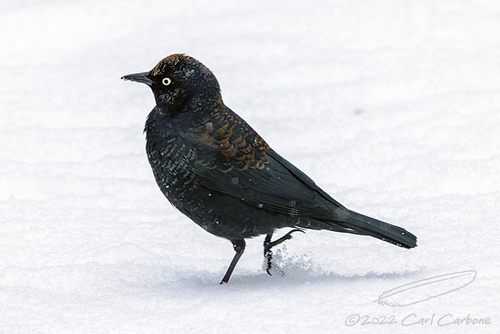
Rusty Blackbird
Euphagus carolinus
A ghostly traveler of the boreal wetlands, the Rusty Blackbird is a rare and rewarding visitor to discover. Known for its 'rusty hinge' song and piercing yellow gaze, this bird brings a touch of wild northern bog to your backyard.
Quick Identification
Size
Length: 8.3–9.8 in (21–25 cm); Wingspan: approx. 14 in (36 cm); Weight: 1.7–2.8 oz (47–80 g)
Colors
Males are glossy black in summer but show distinctive rusty feather edges in winter; females are charcoal-gray with rusty highlights; both sexes feature striking pale yellow eyes.
Key Features
- Piercing pale yellow eyes
- Rusty-edged plumage in winter and migration
- Slender, slightly curved black bill
- Medium-length tail, shorter than a grackle's
When You’ll See Them
Behavior
Rusty Blackbirds are the quiet enigmas of the blackbird family. Unlike their boisterous cousins, the Common Grackles, Rusties are relatively shy and prefer the solitude of wooded wetlands. You will most often find them on the ground, methodically flipping over damp leaves or wading into shallow water to uncover hidden prey. They have a distinctive habit of walking rather than hopping, moving with a deliberate grace as they search for food along the muddy edges of ponds and flooded ditches.
In winter and during migration, they become slightly more social, occasionally joining mixed-species flocks with Red-winged Blackbirds or Starlings, though they typically remain on the periphery. Their song is one of the most unique in the avian world—a creaky, metallic gurgle that sounds remarkably like a rusty hinge being forced open. Because their populations have seen a dramatic decline in recent decades, seeing one in your backyard is a significant event for any citizen scientist.
EverydayEarth exclusive
Camera Tips
To capture high-quality footage of a Rusty Blackbird, your camera placement should be significantly lower than it would be for a cardinal or jay. These birds are dedicated ground-foragers. Position your AI camera between 6 and 12 inches off the ground, aimed toward a damp area of your yard. If you have a natural drainage spot, a muddy puddle, or a shallow water feature with leaf litter, that is your primary target zone. Angle the lens slightly upward to capture the glint in their yellow eyes, which is their most diagnostic feature for AI identification.
Attracting them requires a departure from standard birdseed. While they may occasionally visit a tray feeder for sunflower hearts, they are far more likely to be lured by high-protein offerings. Scatter dried or live mealworms directly onto the ground near your camera, or place suet crumbles in the leaf litter. If you have a birdbath, consider adding a small heater or dripper; the sound of moving water is a powerful magnet for Rusties during their southern migration.
Because Rusty Blackbirds are often active in the dim light of dawn and dusk, ensure your camera's low-light or 'Night Vision' transitions are optimized. They are fast-moving when flipping leaves, so a high trigger speed or a video mode with a high frame rate (60fps) is ideal to prevent motion blur. If your camera allows for zone settings, focus the trigger area on the foreground where you've scattered the mealworms to ensure the AI has a clear, close-up view of the feather detail and eye color.
Similar Species
Species that look similar or are commonly confused with Rusty Blackbird.
Common Grackle
Much larger with a longer, wedge-shaped tail and a thicker, more powerful bill; lacks the rusty feather edging.
Brewer's Blackbird
Prefers drier habitats like parking lots and fields; males have a more uniform glossy sheen without the rusty winter plumage.
Red-winged Blackbird
Males have bright red and yellow shoulder patches; females are heavily streaked like large sparrows and lack the pale yellow eye.
Frequently Asked Questions
Record Rusty Blackbird at your habitat
Connect a camera to start building your own species record — AI identifies every visitor automatically.