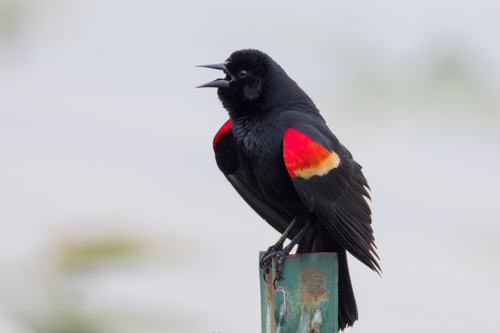
Red-winged Blackbird
Agelaius phoeniceus
The bold sentinel of the marsh, the Red-winged Blackbird is a master of display and one of the most iconic sounds of the American spring.
Quick Identification
Size
Length: 17-23 cm (6.7-9.1 in) | Wingspan: 31-40 cm (12.2-15.7 in) | Weight: 32-77 g (1.1-2.7 oz)
Colors
Males are glossy black with bright red and yellow shoulder patches (epaulets); females are streaked brown and white, resembling a large, dark sparrow.
Key Features
- Distinctive red and yellow shoulder patches on males
- Heavily streaked, grayish-brown plumage on females
- Sharp, conical black beak
- Highly vocal with a metallic 'conk-la-ree' song
When You’ll See Them
Sightings on EverydayEarth
Jun 10, 2026
A female Red-winged Blackbird lands on the white feeder tray and begins foraging. It moves close to the lens, showing its streaked plumage and pointed beak as it searches for food among the seeds.
Apr 8, 2026
A male Red-winged Blackbird lands on the edge of the feeder, using its pointed beak to sift through the mix of peanuts and seeds. After several seconds of feeding and surveying the backyard, it launches into flight.
Mar 17, 2026
A diverse group of birds congregates at the feeding station on a bright day. On the suet feeders to the left, a Red-bellied Woodpecker and a speckled European Starling take turns feeding. The main platform is crowded with Common Grackles and Red-winged Blackbirds. In the background, the partially frozen waters of the pond reflect the afternoon sun.
Aug 2, 2026
A busy scene at the feeders with several species present at once. A Mourning Dove feeds calmly in the central tray while a Downy Woodpecker works on the suet feeder to the left. On the right side, multiple male Red-winged Blackbirds and a Brown-headed Cowbird take turns at the tube feeder, with frequent flying and hopping as they compete for space.
Aug 1, 2026
A speckled European Starling searches through the seed on the platform tray. Moments later, a male Red-winged Blackbird arrives, flashing its bright red shoulder patches as it moves from the center support to a hanging tube feeder.
Aug 1, 2026
A busy afternoon at the feeding station with several species active at once. A male Red-winged Blackbird with bright red and yellow shoulder patches feeds in the large tray alongside two heavily streaked females or juveniles. A Downy Woodpecker is perched on the central wooden post, and a House Finch is visible on the hanging tube feeder to the left.
Behavior
Red-winged Blackbirds are among the most social and vocal birds in North America. During the breeding season, males are fiercely territorial, often perched on high stalks or fence posts, puffing out their feathers and flashing their red shoulder patches to warn off rivals. They are surprisingly bold and have been known to dive-bomb much larger birds, including hawks and crows, or even humans who wander too close to their nesting sites.
Outside of the breeding season, these birds form massive, swirling flocks that can number in the millions, often mixing with other blackbird species and starlings. In the backyard, you'll likely see them as early spring arrivals, dominating bird feeders with their assertive presence. Their movement is energetic, often hopping along the ground or clinging sideways to tall grasses and reeds.
EverydayEarth exclusive
Camera Tips
To capture the perfect shot of a Red-winged Blackbird, position your AI-powered camera near water features or overlooking a tray-style bird feeder. These birds are most active in the early morning when males are performing their territorial displays. Setting your camera at a height of 4 to 5 feet, angled slightly downward toward a perch or feeder, will help you capture the moment a male flares his 'epaulets' (shoulder patches) while singing. If you are placing a camera near a marshy area or tall grass, aim for a clear line of sight to a sturdy stalk where they like to survey their kingdom.
Food is the best lure for bringing them into camera range. They are particularly fond of black oil sunflower seeds, cracked corn, and hulled sunflower seeds. Unlike some smaller songbirds, Red-winged Blackbirds prefer stable surfaces, so platform or tray feeders will yield much better results than small, swaying tube feeders. If you have a ground-level camera, scatter some grain on the soil to capture their frantic foraging behavior, which often involves a 'double-scratch' motion to uncover seeds.
Because these birds are incredibly fast and reactive, ensure your camera's shutter speed or capture frequency is set to high. Their 'conk-la-ree' display happens in a split second—the bird hunches forward, spreads its tail, and vibrates its wings to show off the red. If your camera has an AI 'bird' mode, it will excel here, as the high-contrast black plumage of the male makes him an easy target for the sensor to lock onto. During the winter, look for large groups; a wider-angle lens setting can capture the impressive scale of a flock descending on your yard.
Don't overlook the females! Because they look so different from the males—more like large, streaked sparrows—many backyard observers miss them. Place a second camera closer to the ground or in denser shrubbery near your feeder, as females tend to be slightly more secretive than the flashy, boastful males. In the spring, providing nesting materials like dry string or pet fur can also draw them directly in front of the lens.
Similar Species
Species that look similar or are commonly confused with Red-winged Blackbird.
Tricolored Blackbird
Almost identical to the Red-winged, but the shoulder patch is a darker red and the lower stripe is bright white instead of yellow.
Brown-headed Cowbird
Smaller with a shorter, thicker beak; males have a brown head and glossy black body without any red wing patches.
European Starling
Starlings have yellow beaks in spring and speckled plumage, lacking the specific red shoulder markings of the blackbird.
Frequently Asked Questions
Record Red-winged Blackbird at your habitat
Connect a camera to start building your own species record — AI identifies every visitor automatically.