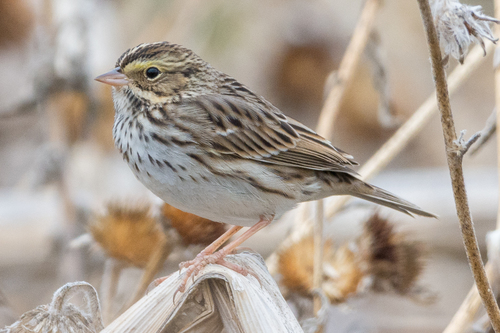
Savannah Sparrow
Passerculus sandwichensis
Look closely for the signature yellow 'eyebrows' of the Savannah Sparrow, a small but hardy songster of the open grasslands. This master of camouflage is often found scurrying through the meadows like a mouse, only revealing itself when it takes to a fence post to sing its buzzy, insect-like song.
Quick Identification
Size
Length: 4.3–5.9 in (11–15 cm); Wingspan: 7.1–9.8 in (18–25 cm); Weight: 0.5–1.0 oz (15–28 g)
Colors
Brown and grey streaked upperparts, white or buff underparts with crisp dark streaks; most individuals show a distinctive yellow patch on the lores (between the eye and bill).
Key Features
- Small yellow patch above and in front of the eye
- Short, notched tail
- Finely streaked breast often converging into a small central spot
- Small, thin bill compared to other sparrows
When You’ll See Them
Behavior
Savannah Sparrows are the quintessential birds of the open field. Unlike many other sparrows that prefer dense thickets or scrubby forest edges, these birds are most at home in wide-open grasslands, meadows, and salt marshes. They are known for their ground-dwelling habits; you will often see them running or walking through the grass with a mouse-like scurrying motion rather than hopping. During the breeding season, males are bold performers, perched atop a tall weed or fence post to deliver a high-pitched, buzzy song that sounds remarkably like a grasshopper.
When they aren't singing, they are masters of camouflage. If approached, they tend to stay low in the vegetation until the very last second, flushing in a quick, zig-zagging flight before diving back into cover. In the winter, they become more social, often joining loose flocks with other grassland-loving species to forage for seeds in agricultural stubble and coastal dunes. They are generally wary of human interaction but can be quite predictable in their habitat use, returning to the same fields year after year.
EverydayEarth exclusive
Camera Tips
To capture high-quality footage of a Savannah Sparrow, ground-level placement is your best strategy. Position your AI-powered camera 6 to 12 inches off the ground, ideally aimed at a small clearing within a grassy area or a patch of bare soil near a field edge. Because they spend so much time on foot, a low angle provides an intimate view of their facial markings—particularly those yellow lores—that you would miss from a standard tree-mounted position.
If your property has a fence line, consider mounting a second camera facing one of the top rails or a prominent fence post. These are the preferred 'stages' for males to sing and survey their territory. A camera aimed at a fence post with a clear background can produce stunning, professional-looking portraits during the spring and summer months when the birds are most territorial and vocal.
While Savannah Sparrows aren't usually attracted to hanging feeders, you can successfully lure them into your camera's frame by scattering a 'ground mix' of white proso millet or fine cracked corn. Choose a spot with short grass so the bird feels safe from ground predators but isn't entirely obscured by tall weeds. Use a high-sensitivity motion setting on your camera; these birds are small and move with quick, darting motions that can be missed by slower sensors.
Lighting is crucial for capturing the subtle brown-on-grey streaking of their plumage. Try to orient your camera so the morning sun is at its back. This 'golden hour' light brings out the yellow highlights near the eye and prevents the white underparts from appearing overexposed. In the winter, focus your efforts on coastal areas or agricultural fields where they congregate in larger numbers.
Similar Species
Species that look similar or are commonly confused with Savannah Sparrow.
Song Sparrow
Larger with a longer, rounded tail and lacks the yellow lores (eyebrow) of the Savannah Sparrow.
Vesper Sparrow
Slightly larger with a distinct white eye-ring and white outer tail feathers that are visible in flight.
Grasshopper Sparrow
Has a much flatter head and an unstreaked, buffy breast, whereas the Savannah is heavily streaked.
Frequently Asked Questions
Record Savannah Sparrow at your habitat
Connect a camera to start building your own species record — AI identifies every visitor automatically.