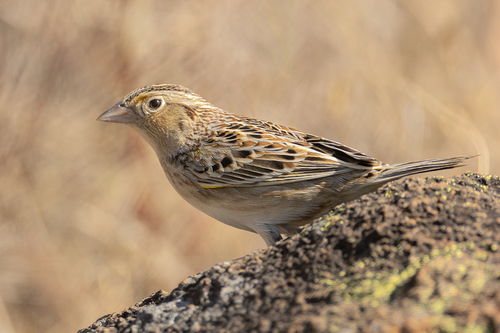
Grasshopper Sparrow
Ammodramus savannarum
The Grasshopper Sparrow is the ultimate grassland specialist, known for its mouse-like scurrying and a buzzy song that sounds more like an insect than a bird. A master of camouflage, this elusive sparrow is a crown jewel for any backyard wildlife enthusiast with an open field.
Quick Identification
Size
Length: 4.3–5.1 in (11–13 cm); Wingspan: 6.7–7.9 in (17–20 cm); Weight: 0.5–0.7 oz (14–20 g)
Colors
Buff and brown mottled upperparts with reddish-brown streaks; unstreaked creamy breast and belly; distinctive yellow-orange patch on the lores (between eye and bill).
Key Features
- Distinctive yellow-orange spot in front of the eyes
- Flat-headed profile with a relatively large bill
- Short, spiked tail
- Buzzy, insect-like song that sounds like a grasshopper
When You’ll See Them
Geographic range
Where Does the Grasshopper Sparrow Live?
Native to the North American continent, the Grasshopper Sparrow maintains a wide breeding range across the central and eastern United States and southern Canada. As winter approaches, these birds migrate to the southern United States, Mexico, and Central America, with some populations reaching the Caribbean islands. They are particularly concentrated in the Great Plains, though they can be found in suitable coastal grasslands and agricultural corridors.
Basemap © OpenStreetMap contributors
Behavior
The Grasshopper Sparrow is one of the most elusive birds of the open field, often behaving more like a mouse than a bird. Rather than flying when startled, it frequently runs through the grass understory to escape detection. They are highly specialized grassland birds, requiring large, treeless expanses where they can forage and nest in relative safety from perch-hunting predators.
During the breeding season, males are most noticeable when they perch on a sturdy weed stalk or fence wire to deliver their mechanical, buzzy song. These birds are somewhat nomadic; if a particular field becomes unsuitable due to overgrowth or farming practices, they will quickly abandon the site to find better 'heterogeneous' patches—areas with a mix of bare ground for walking and thick clumps for nesting.
EverydayEarth exclusive
Camera Tips
Capturing a Grasshopper Sparrow on camera requires a different strategy than your typical feeder bird. Because they are ground-dwelling 'skulkers,' you should position your camera very low to the ground—no more than 6 to 12 inches high. Angle the lens slightly upward to capture them as they forage in the short-grass gaps between thicker vegetation clumps.
Since these birds rarely visit traditional bird feeders, the best way to lure them into frame is by providing a low-profile water source. A shallow, ground-level birdbath or a dripping water feature placed in an open, grassy area can be irresistible to them during the heat of the day. Ensure there are no tall shrubs within 15 feet of the camera, as these sparrows generally avoid areas where predators like hawks can perch and watch them.
Set your camera to a fast shutter speed or 'burst' mode if available. These birds move with quick, jerky motions and can vanish into the thatch in a split second. Early morning is the optimal time for filming, as males will often use a prominent twig or fence post near your camera setup as a singing perch to defend their territory.
Similar Species
Species that look similar or are commonly confused with Grasshopper Sparrow.
Savannah Sparrow
Has a heavily streaked breast and a smaller bill compared to the unstreaked breast of the Grasshopper Sparrow.
Henslow's Sparrow
Features a distinctive olive-green wash on the head and more intricate scaling on the back.
LeConte's Sparrow
Has much brighter orange-buff tones on the face and a greyish ear patch.
Frequently Asked Questions
Record Grasshopper Sparrow at your habitat
Connect a camera to start building your own species record — AI identifies every visitor automatically.