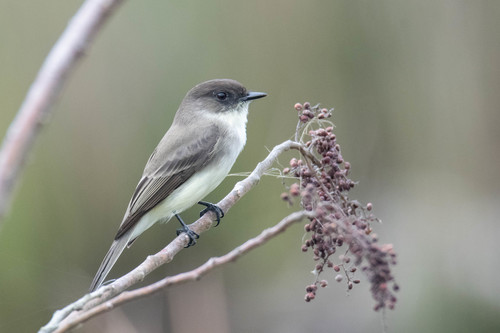
Eastern Phoebe
Sayornis phoebe
The Eastern Phoebe is a friendly, tail-wagging flycatcher that marks the arrival of spring. Known for its habit of nesting on porches and bridges, it is one of the most accessible wild neighbors for backyard birders.
Quick Identification
Size
Length: 14–17 cm (5.5–6.7 in) | Wingspan: 23–28 cm (9.1–11 in) | Weight: 16–21 g (0.6–0.7 oz)
Colors
Muted grayish-brown upperparts with a noticeably darker, sooty-brown head. Underparts are off-white, often showing a faint yellowish wash in autumn. No distinct wing bars or eye rings.
Key Features
- Frequent downward tail-wagging or 'pumping' motion
- Sooty-black head usually darker than the rest of the back
- Lack of prominent white wing bars or eye rings
- Sharp, raspy 'fee-bee' vocalization
When You’ll See Them
Geographic range
Where Does the Eastern Phoebe Live?
The Eastern Phoebe is a quintessential North American native, with a breeding range that stretches across the eastern and central United States and up into the boreal forests of Canada. As a migratory species, it spends its winters in the southern United States and throughout Mexico, though a few hardy individuals may remain in the Mid-Atlantic during milder winters. Because it relies on man-made structures for nesting, its range is closely tied to human development and agricultural landscapes throughout the continent.
Basemap © OpenStreetMap contributors
Behavior
The Eastern Phoebe is a hardy and charismatic flycatcher known for being one of the first signs of spring in North America. Unlike many other insectivores, it arrives early in the season and stays late into the fall. It is easily recognized by its rhythmic tail-wagging—a constant downward dipping motion performed while perched. This behavior, combined with its namesake call, makes it one of the most approachable and identifiable backyard birds.
These birds are solitary by nature but have developed a unique relationship with humans. They are 'synanthropic,' meaning they frequently choose to live near people, often building their mud-and-moss nests on porch ledges, under eaves, or beneath bridges. They are patient hunters, sitting still on low branches before darting out to snatch insects from the air with an audible snap of their beak.
EverydayEarth exclusive
Camera Tips
Capturing the Eastern Phoebe on camera is highly rewarding because of their predictable perching habits. These birds are sit-and-wait predators; they will often return to the exact same twig or fence post after a flight to catch an insect. Position your AI camera about 5-8 feet away from a known 'hunting perch'—usually a low, exposed branch near water or an open lawn. Use a fast trigger speed (0.2 seconds or less) to catch the moment they launch into flight or return with a meal.
Since Eastern Phoebes are famous for nesting on man-made structures, you can get incredible 'nest-cam' footage by mounting a camera under the eaves of your house or near a porch light where they have built a nest. Angle the camera slightly from the side rather than directly looking in to avoid disturbing the parents. Because they use mud and moss for their nests, they are often attracted to small ledge-style birdhouses or even simple wooden platforms. If you have a backyard pond or birdbath, place your camera nearby; they aren't frequent drinkers, but they love the insects that congregate near water.
For the best lighting, aim for the golden hours of early morning. Phoebes are very active at dawn, often being the first birds to start calling. Settings-wise, a high frame rate for video (60fps) is excellent for capturing the characteristic tail-pump, which happens almost every few seconds when they are perched. If your camera allows for zone-triggering, focus on the area just above the perch, as they often hover for a split second before landing.
Similar Species
Species that look similar or are commonly confused with Eastern Phoebe.
Frequently Asked Questions
Record Eastern Phoebe at your habitat
Connect a camera to start building your own species record — AI identifies every visitor automatically.