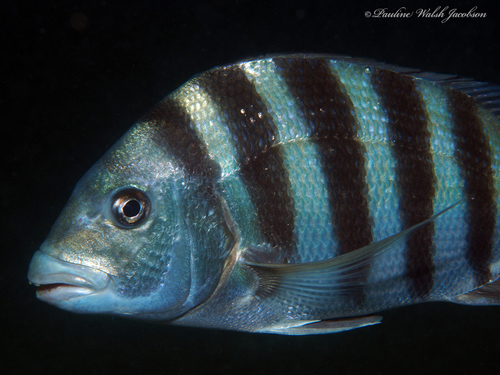
Sheepshead
Archosargus probatocephalus
Recognizable by its bold 'convict' stripes and remarkably human-like teeth, the Sheepshead is the cleverest resident of the coastal dock. A master at navigating submerged structures, this species offers a fascinating look into the world of specialized underwater foragers.
Quick Identification
Size
Typically 10–20 inches (25–50 cm) in length and 3–15 lbs (1.4–6.8 kg), though trophy specimens can reach 30 inches and over 20 lbs.
Colors
Dull silver or gray body with 5–6 prominent vertical black bars; fins are generally dark or dusky gray.
Key Features
- Human-like incisor and molar teeth used for crushing shells
- 5-6 distinct vertical black 'convict' stripes on a silver body
- Strong, sharp dorsal and anal spines
- Deep, compressed oval-shaped body profile
When You’ll See Them
Sightings on EverydayEarth
Jul 28, 2026
A large West Indian Manatee floats calmly in the clear spring water near a surface-level feeding station containing leafy greens. Several fish, including striped Sheepshead, swim actively around the manatee and the feeding frame. The manatee appears to be resting or slowly maneuvering toward the food.
Jul 23, 2026
A diverse group of fish is active in the clear spring water. Several Sheepshead swim prominently in the foreground and midground, occasionally approaching the camera. Smaller Gray Snappers and streamlined Common Snook move through the lower portion of the frame and near the algae-covered structure at the top of the scene.
Jul 23, 2026
Several fish swim through the clear, sunlit water of Homosassa Springs. Sheepshead with their prominent black stripes are seen navigating near a floating, algae-covered log at the surface, while more slender Gray Snappers cruise in the middle of the water column. Fine particles of organic matter drift slowly with the gentle current.
Jul 23, 2026
A West Indian Manatee drifts calmly on the right side of the frame, showcasing its large, paddle-like tail. Several Sheepshead fish with their characteristic black stripes and a few Gray Snappers swim actively through the sunlit, clear spring water. The scene is peaceful with light filtering down from the surface where a wooden structure is visible.
Jul 23, 2026
Several species of fish are active in the crystal-clear water of the spring. A Sheepshead with vivid black stripes swims directly toward and past the camera lens. In the background, a Common Snook and several Gray Snappers glide near a submerged rectangular structure as sunlight filters through the surface.
Jul 22, 2026
A West Indian Manatee swims and feeds on floating lettuce within a buoyant pipe frame. Several small fish, including a Sheepshead with its characteristic vertical stripes, are visible swimming through the clear spring water around the manatee.
Behavior
Sheepshead are intelligent and highly specialized foragers often referred to as the 'convict fish' due to their striped appearance and their notorious ability to 'steal' bait from hooks without being detected. Unlike many predatory fish that strike quickly, Sheepshead are methodical grazers. They spend much of their time hovering near submerged structures, using their unique, heavy teeth to pick barnacles off pilings or crush the shells of small crustaceans.
These fish are relatively social and are often found in small schools or loose aggregations, particularly when food is abundant. While they are not overly aggressive, they are quite wary and have excellent eyesight, making them quick to retreat into deeper water or behind structures if they perceive a threat. In the winter months, they typically move offshore to spawn in deeper, warmer waters before returning to coastal estuaries and bays in the spring.
EverydayEarth exclusive
Camera Tips
Capturing Sheepshead on an underwater backyard or dock camera requires a focus on structure. Because these fish are vertically oriented, the best camera placement is directly facing a barnacle-encrusted piling or a section of a rock jetty. Mount your camera at a depth of 3 to 5 feet below the low-tide line. This is the 'sweet spot' where Sheepshead move along the structure to graze. Ensure the lens is angled slightly downward to catch the fish as they tilt their bodies to scrape food off the surface.
To guarantee a visit from a Sheepshead, use the 'scrape and film' method. Instead of bringing external bait that might attract unwanted scavengers, use a long-handled scraper to crush a few barnacles or oysters directly in front of your camera lens. The scent of fresh shellfish is an irresistible natural lure that will keep Sheepshead hovering in front of the AI sensor for several minutes. If you are using a cage-style bait station, fill it with crushed blue crab or shrimp to create a persistent scent trail.
Lighting and water clarity are your biggest challenges. Sheepshead are most active during daylight hours, so take advantage of natural light. Position your camera facing away from the direct morning or evening sun to avoid lens flare and silhouetting. If your water is high in turbidity (common in the estuaries Sheepshead love), keep the camera within 18-24 inches of the structure you are monitoring. This ensures the AI can clearly identify the vertical black bars, which are the primary marker for species recognition.
Finally, be mindful of the tide and current. Sheepshead are most active when there is a steady movement of water, which brings in nutrients and oxygen. Set your camera to record high-frame-rate bursts during the two hours before and after high tide. During the late winter spawning season, you may need to move your equipment to deeper water or more saline environments closer to the ocean, as the fish will temporarily vacate shallow residential canals and brackish marshes.
Similar Species
Species that look similar or are commonly confused with Sheepshead.
Frequently Asked Questions
Record Sheepshead at your habitat
Connect a camera to start building your own species record — AI identifies every visitor automatically.