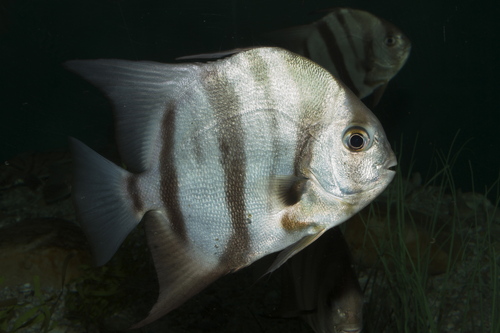
Atlantic Spadefish
Chaetodipterus faber
Meet the 'Angelfish of the Atlantic,' a silver-scaled beauty known for its unique spade-shaped silhouette and striking vertical stripes. These social reef-dwellers are a favorite for coastal observers and a highlight for any underwater camera enthusiast.
Quick Identification
Size
Typically 30 to 45 cm (12–18 inches), though they can reach up to 90 cm (35 inches) and weigh up to 9 kg (20 lbs).
Colors
Silver or grayish-white body with 4 to 6 prominent vertical black bars; markings may fade in older individuals.
Key Features
- Distinctive disc-shaped or spade-shaped body profile
- Five to six dark vertical bars on a silver background
- Small mouth with a blunt snout
- Deeply notched dorsal fin with wing-like posterior fins
When You’ll See Them
Geographic range
Where Does the Atlantic Spadefish Live?
The Atlantic Spadefish is native to the western Atlantic Ocean, stretching from the temperate coastal waters of Massachusetts in the United States down through the Gulf of Mexico and the Caribbean Sea. Their core range encompasses the eastern coast of the Americas, reaching as far south as southeastern Brazil. They are particularly common in the South Atlantic Bight during the summer months, where they migrate toward shore to aggregate around artificial reefs and structural landmarks.
Basemap © OpenStreetMap contributors
Behavior
Atlantic Spadefish are highly social and gregarious creatures, most often found in large, synchronized schools that can number in the hundreds. These schools typically congregate around vertical structures such as shipwrecks, oil platforms, and dock pilings. They are known for their curious and relatively fearless nature, often approaching divers or underwater camera equipment to investigate new objects in their environment.
Feeding primarily during the daylight hours, they utilize their small mouths to nibble on encrusting organisms. While they are a favorite for recreational anglers due to their fighting strength, they are generally peaceful toward other fish species. In their juvenile stage, they exhibit a clever survival tactic known as mimicry; they often float on their sides in shallow water to resemble dead leaves or floating debris, successfully evading predators in mangrove and sandy beach habitats.
EverydayEarth exclusive
Camera Tips
Capturing the Atlantic Spadefish requires a specialized underwater camera setup, such as a waterproof trail camera or an AI-powered marine housing. For the best results, mount your camera directly to a submerged structure like a dock piling or a reef ball about 5 to 15 feet below the surface. Use a wide-angle lens setting to capture the full scale of their schooling behavior, as these fish rarely travel alone and can quickly fill the entire frame with their striking silver-and-black patterns.
Because Spadefish are naturally curious, they are easily attracted to visual stimuli without much effort. You don't necessarily need food bait; a small, shiny piece of metal or a reflective 'flasher' dangling in the current near the camera can pique their interest and bring the school within close range of the lens. If you choose to use a lure, a small mesh bag filled with chopped clams or shrimp (chum) can keep the school stationary in front of your camera for extended periods, providing consistent 'hits' for your AI detection software.
Lighting is your best friend when photographing this species. Atlantic Spadefish are most active and their silver scales most vibrant under the midday sun when light penetrates the water most effectively. Ensure your camera is angled slightly away from the direct sun to avoid silhouette effects. In the summer months, look for 'cleaning stations' on reefs where Spadefish gather to have parasites removed by smaller fish, as this provides a predictable and stationary location for high-quality captures.
Similar Species
Species that look similar or are commonly confused with Atlantic Spadefish.
Sheepshead
Sheepshead have a more elongated body, a larger mouth with visible teeth, and lack the spade-like fin shape.
Queen Angelfish
Queen Angelfish have vibrant blue and yellow coloring and a 'crown' on their forehead, unlike the silver/black Spadefish.
Banded Butterflyfish
Much smaller in size with only 2-3 thick black bands and a pointed snout.
Frequently Asked Questions
Record Atlantic Spadefish at your habitat
Connect a camera to start building your own species record — AI identifies every visitor automatically.