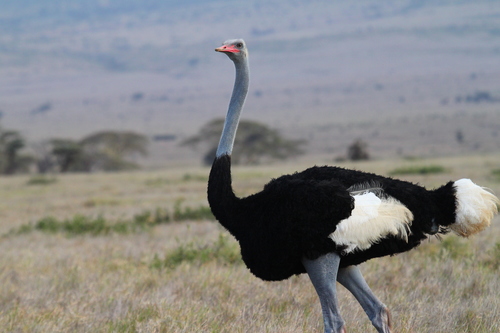
Somali Ostrich
Struthio molybdophanes
Meet the 'Blue-necked' giant of the desert. The Somali Ostrich is a stunning, blue-skinned icon of the Horn of Africa, standing tall as one of the world's most impressive flightless birds.
Quick Identification
Size
Height: 2–2.7 meters (6.6–9 ft); Weight: 90–130 kg (200–290 lbs)
Colors
Males have black body plumage with distinct blue-grey skin on the neck and thighs; females are brown-grey and slightly smaller.
Key Features
- Distinctive blue-grey skin on the neck and thighs of males
- White ring around the base of the neck is often absent or faint
- Extremely large, dark eyes with long lashes
- Two-toed feet with one large claw on the inner toe
When You’ll See Them
Behavior
The Somali Ostrich is a more solitary and territorial creature compared to its common cousin. While they can be found in small groups, they are frequently seen roaming the arid landscapes in pairs or even alone. They are incredibly wary of predators and use their height to scan the horizon, often acting as a sentinel for other species like zebras and gazelles.
During the breeding season, males perform elaborate displays, crouching down and rhythmically waving their wings to show off their white feathers against their blue skin. Their vocalizations are surprising; instead of a chirp, the male produces a deep, booming roar that can sound like a distant lion, used to defend his territory and attract females.
While they are wild animals, they have a long history of interaction with local communities in the Horn of Africa, where they have been partially domesticated for their feathers and meat for centuries. However, in the wild, they remain elusive and fast, capable of reaching speeds up to 45 mph to escape threats.
EverydayEarth exclusive
Camera Tips
When setting up an AI-powered camera for the Somali Ostrich, the most critical factor is height. Because these birds can stand nearly nine feet tall, a standard low-mounted trail camera will likely only capture their legs. Aim to mount your camera at a height of 4 to 5 feet, angled slightly upward, or place it on a higher vantage point overlooking a known trail to ensure you capture the distinctive blue neck and head.
In the semi-arid regions where they live, water is the primary draw. Positioning your camera near a watering hole or a temporary pan after a rainstorm is the most effective way to get clear, front-facing shots. Since they are large and move with a long stride, use a 'wide-angle' lens setting if available to keep the entire bird in the frame as it passes by.
To avoid blurry images of a bird that can move at 45 miles per hour, set your camera to a fast shutter speed and utilize 'Burst Mode.' This will allow you to capture a sequence of frames, increasing the chances of a perfect shot of their behavioral displays or their high-speed gait. Daylight is your best friend here, so ensure the camera is positioned to avoid direct lens flare during the golden hours of early morning and late afternoon.
Avoid using traditional food baits, as these birds are specialized foragers. Instead, focus on natural bottlenecks in the landscape—like gaps in thorny brush or paths leading to water. If you are in a legal and safe area to do so, a large mirror placed securely at ground level can sometimes trigger a male's territorial curiosity, leading him to display directly in front of your lens, though this should be used sparingly to avoid stressing the bird.
Similar Species
Species that look similar or are commonly confused with Somali Ostrich.
Frequently Asked Questions
Record Somali Ostrich at your habitat
Connect a camera to start building your own species record — AI identifies every visitor automatically.