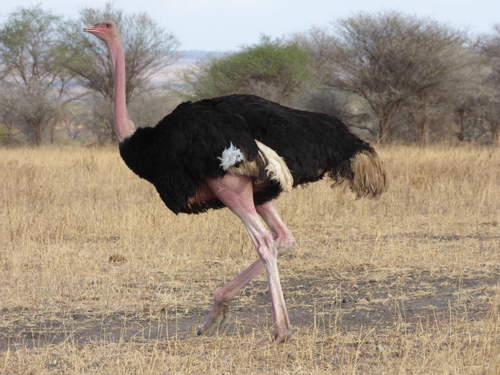
Common Ostrich
Struthio camelus
The Common Ostrich is the undisputed heavyweight champion of the avian world. This flightless giant of the African savanna can outrun a racehorse and stands as a living link to the age of the dinosaurs.
Quick Identification
Size
Height: 1.7–2.8 m (5.6–9.2 ft); Weight: 63–145 kg (140–320 lbs)
Colors
Males feature bold black body feathers with white wing and tail plumes; females and juveniles are uniform earthy grey-brown.
Key Features
- Massive size and long, bare neck
- Two toes on each foot with a large 4-inch claw
- Enormous eyes, the largest of any land vertebrate
- Powerful, muscular legs designed for high-speed running
When You’ll See Them
Sightings on EverydayEarth
Jul 23, 2026
A male Common Ostrich is seen foraging in the open, scrubby landscape. It walks slowly across the dry ground, occasionally lowering its long neck to peck at the earth in search of food before briefly looking up at its surroundings.
Jul 18, 2026
A large African Elephant stands at the edge of the waterhole, using its trunk to explore the ground. In the background, a Puku stands still and alert, while a small group of ostriches is visible on the far left bank. The scene is a busy daytime gathering at the water source.
Jun 20, 2026
A group of White Rhinoceros is gathered in a sandy clearing, with some resting while others forage near the trees. A male Common Ostrich walks casually through the middle of the herd, pecking at the ground.
Jun 17, 2026
A group of three White Rhinoceroses are peacefully grazing in a large dirt clearing. A Common Warthog enters the frame from the right, trotting across the middle ground with its tail held high. In the far background behind the fence, a Common Ostrich can be seen walking past.
Jun 9, 2026
Under the cover of night, a Cheetah rests in the center of a clearing while another Cheetah in the background stands up. A Common Ostrich walks calmly across the scene from left to right, passing between the two resting predators without any signs of distress.
May 29, 2026
A group of White Rhinoceroses is gathered in a woodland enclosure; several are resting on the ground while others stand near the back fence. A male Common Ostrich walks purposefully across the middle ground from left to right. Small Western Cattle-Egrets are also present, moving around the feet of the rhinos in search of insects.
Geographic range
Where Does the Common Ostrich Live?
The Common Ostrich is a majestic resident of the African continent, primarily found in the sub-Saharan regions spanning the Sahel, East Africa, and Southern Africa. Their range extends from the open grasslands of Kenya and Tanzania down to the arid shrublands of Namibia and South Africa. While they once inhabited parts of the Middle East, they are now a quintessential symbol of the African savanna, thriving in landscapes where their keen eyesight can spot movement from miles away.
Basemap © OpenStreetMap contributors
Recorded on EverydayEarth
Behavior
Ostriches are highly social, nomadic birds that typically roam the African plains in groups of five to fifty individuals. These groups are often led by a dominant male and a 'major' female, who together manage communal nesting sites. Despite the popular myth, ostriches do not bury their heads in the sand when scared; instead, they either run away at speeds up to 45 mph or lie flat against the ground to camouflage their bodies against the terrain.
Their social life is complex, especially during the breeding season. Males perform elaborate displays, including a rhythmic 'wing dance' and booming vocalizations that can sound like a lion's roar from a distance. They are also incredibly protective; a single kick from an ostrich's powerful leg is strong enough to kill a potential predator like a lion.
EverydayEarth exclusive
Camera Tips
Capturing the world's largest bird on a trail camera requires a unique setup compared to smaller wildlife. Because ostriches are exceptionally tall, you must mount your camera much higher than usual—ideally between 4 and 5 feet (1.2–1.5 meters). If the camera is too low, you may only capture shots of their legs. Angle the lens slightly upward to ensure you catch the head and neck, which are the most diagnostic parts of the bird, especially when they are curious and lean in to investigate the device.
Watering holes are the gold standard for ostrich photography. In arid environments, ostriches visit communal water sources daily, providing a predictable spot for high-quality captures. If you are placing a camera in an open field, look for wide, well-worn game trails. Ostriches are creatures of habit and will often use the same paths to move between grazing areas. Because they are highly curious, they may peck at the camera; using a sturdy, lockable security box is essential to prevent them from knocking the camera out of alignment or damaging the lens.
Lighting is another critical factor. Because of their immense height, the midday sun can create harsh shadows on their bodies. Position your camera to face North or South to take advantage of the softer side-lighting during the early morning and late afternoon when they are most active. If your camera supports it, use a high-speed burst mode or high-definition video. Their movements, while graceful, can be surprisingly fast, and a single still photo might result in motion blur as they bob their heads while walking.
Similar Species
Species that look similar or are commonly confused with Common Ostrich.
Somali Ostrich
Features blue-grey skin on the neck and thighs rather than the pink or greyish skin of the Common Ostrich.
Greater Rhea
A much smaller flightless bird found in South America with three toes instead of two.
Emu
Native to Australia, these birds are shorter and have shaggier, darker feathers covering their necks.
Frequently Asked Questions
Record Common Ostrich at your habitat
Connect a camera to start building your own species record — AI identifies every visitor automatically.