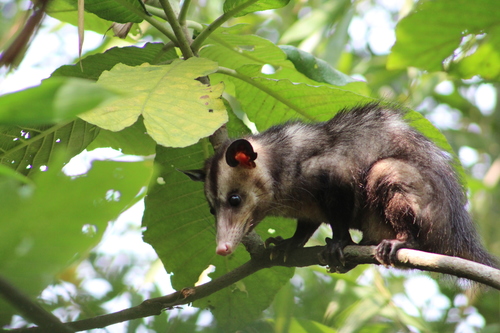
Southern Opossum
Didelphis marsupialis
The Southern Opossum is Central and South America’s most famous nighttime wanderer. Often spotted by AI cameras in backyard gardens, these resilient marsupials are essential for keeping local ecosystems healthy and pest-free.
Quick Identification
Size
Body length: 35–50 cm (14–20 in); Tail length: 35–45 cm (14–18 in); Weight: 1–2 kg (2.2–4.4 lbs)
Colors
Coarse yellowish-gray fur with darker guard hairs; distinctive white or pale cream facial mask; solid black ears; long, scaly prehensile tail with a black base and white tip.
Key Features
- Solid black ears without white tips
- White or pale yellow facial mask
- Long, scaly, hairless prehensile tail
- Opposable 'thumbs' (hallux) on the hind feet
When You’ll See Them
Sightings on EverydayEarth
Aug 1, 2026
A Common Opossum moves across the fruit feeder platform under infrared light. It sniffs the surface and picks up a piece of fruit, chewing it while looking toward the camera with visible eyeshine.
Jul 31, 2026
A Common Opossum is active under the cover of darkness, navigating across a large log at the feeder. It pauses several times to sniff the surface and investigate the vegetation for potential food sources.
Jul 17, 2026
A Common Opossum explores the fruit tray at night, carefully sniffing and feeding on the provided citrus slices. It moves methodically across the platform, using its sensitive nose to select pieces of fruit.
Jul 17, 2026
A Common Opossum is active on the fruit feeder at night, moving across the platform and sniffing the sliced fruit provided.
Jul 11, 2026
A Common Opossum is perched on the feeder platform at night, feeding on halved fruits. It spends most of the time with its back to the camera, showcasing its long tail, before occasionally turning its head to reveal its pale face and prominent dark ears.
Jul 8, 2026
A Common Opossum carefully navigates the feeder platform under the cover of night. It pauses to scan its surroundings with glowing eyes before settling down to forage among the scattered pieces of fruit.
Behavior
The Southern Opossum is a highly adaptable and solitary marsupial that plays a vital role as a generalist scavenger. While they are primarily terrestrial, they are exceptional climbers and use their prehensile tails as a fifth limb when navigating the forest canopy or garden fences. Unlike many other mammals, they are not strictly territorial and tend to wander within a shifting home range, looking for food and temporary dens in hollow logs, rock crevices, or even man-made structures.
As marsupials, females possess a well-developed pouch where they carry their young for several months. They are remarkably resilient to snake venom and are known for their 'cleanup' services, as they consume a wide variety of pests including cockroaches, ticks, and small venomous snakes. While their northern cousins are famous for 'playing possum' (thanatosis), the Southern Opossum is more likely to growl or hiss when threatened, though they are generally non-aggressive toward humans and prefer to retreat into the shadows.
EverydayEarth exclusive
Camera Tips
To capture high-quality footage of the Southern Opossum, place your camera low to the ground, approximately 12 to 18 inches high. This species frequently travels along 'wildlife highways'—linear features like the base of garden walls, fallen logs, or the edges of dense shrubbery. If you can identify a clear path through the leaf litter, aim your camera parallel to the trail to capture the animal's full length as it passes by.
Because Southern Opossums are strictly nocturnal, your camera’s Infrared (IR) flash performance is critical. To avoid 'white-out' (where the animal appears as a glowing white ghost), ensure the camera is not aimed too closely at a reflective surface like a white wall or shiny leaves. If your camera allows for sensitivity adjustments, set it to 'High' to ensure the motion sensor triggers quickly enough to catch them before they scurry out of the frame. I recommend using video mode with 15-second clips; this allows you to see their unique waddling gait and, if you're lucky, the sight of a mother carrying older 'joeys' on her back.
While they are naturally curious and will investigate new smells, you can increase your success rate by using a scent lure. A small amount of overripe fruit (like bananas or mangoes) or a smear of peanut butter on a nearby tree trunk can pause the opossum in front of your lens for several seconds. If you are in a suburban area, placing the camera near the base of a compost bin or under a fruit-bearing tree is almost a guaranteed way to spot them. In tropical regions, be sure to use a desiccant pack inside your camera housing to prevent lens fogging during humid nights.
Similar Species
Species that look similar or are commonly confused with Southern Opossum.
Frequently Asked Questions
Record Southern Opossum at your habitat
Connect a camera to start building your own species record — AI identifies every visitor automatically.