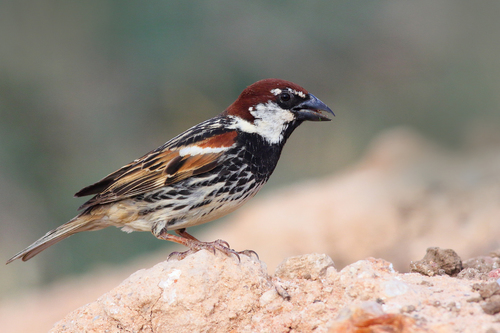
Spanish Sparrow
Passer hispaniolensis
A vibrant and gregarious inhabitant of the Mediterranean, the Spanish Sparrow is defined by its striking streaked plumage and bustling social life. More 'wild' than its House Sparrow cousin, this bird brings a flurry of energy and a chorus of song to any backyard it visits.
Quick Identification
Size
Length: 15–16 cm (5.9–6.3 in); Wingspan: 23–26 cm (9–10 in); Weight: 24–36 g (0.8–1.3 oz)
Colors
Males feature a vibrant chestnut-red crown, white cheeks, and a dense black bib that extends into heavy streaking on the flanks. Females are sandy-brown with subtle pale streaking on the back and underparts.
Key Features
- Bright chestnut-red crown in males (replaces the grey crown of House Sparrows)
- Heavy black streaking along the breast and flanks
- Thick, conical black bill designed for seed-cracking
- Distinctive white cheek patches and pale 'eyebrow' line
- Highly social behavior, usually seen in large flocks
When You’ll See Them
Behavior
The Spanish Sparrow is a quintessential socialite of the bird world. Rarely found in isolation, these birds live their lives in bustling, high-energy colonies. They are known for their 'noisy' personality, often filling the air with a constant chorus of chirps and metallic calls. While they are closely related to House Sparrows, they are generally more nomadic and less tethered to human structures, though they are increasingly common visitors to suburban gardens in the Mediterranean and Western Asia.
Their social structure is fascinating, particularly during the nesting season. They often build massive, untidy grass nests in dense colonies, sometimes even constructing them within the lower twigs of larger birds' nests, such as those belonging to White Storks or raptors. In a backyard environment, they move with a frantic, hopping energy, frequently engaging in 'social bathing' where an entire flock will descend upon a water source at once.
EverydayEarth exclusive
Camera Tips
To capture the best footage of Spanish Sparrows, you must account for their group dynamics. Instead of focusing your AI camera on a single perch, aim it at a wide-platform feeder or a large, shallow bird bath. Spanish Sparrows prefer to feed and bathe in groups, so a wider field of view will allow you to capture the fascinating social interactions between multiple individuals. Set your camera at a height of 3 to 5 feet, ideally near a 'staging' area like a dense hedge or shrub where they can retreat if they feel threatened.
Because these birds are small and move quickly, use a high-sensitivity trigger setting and set your video duration to at least 20 seconds. This ensures you catch the full sequence of a bird arriving, feeding, and departing. If your camera has an adjustable focal length, try to get as close as 3 feet to the feeder; this will help the AI distinguish the specific black streaking on the male's flanks, which is the primary field mark that separates them from the nearly identical House Sparrow.
Lighting is your best friend when trying to identify this species. Position your camera so the morning sun hits the feeder directly. This will illuminate the rich chestnut-red crown of the male, making for a 'hero shot' that clearly differentiates it from its grey-headed cousins. During the spring, consider placing some nesting material like dried grass or small feathers near the camera's view; capturing a sparrow gathering these materials provides a wonderful glimpse into their industrious nesting habits. Avoid placing the camera in high-wind areas, as their light weight makes them prefer sheltered spots for feeding.
Similar Species
Species that look similar or are commonly confused with Spanish Sparrow.
House Sparrow
The male House Sparrow has a grey crown and a solid black bib, whereas the Spanish Sparrow has a chestnut crown and heavy black streaking on its sides.
Eurasian Tree Sparrow
Tree Sparrows have a solid chocolate-brown crown and a distinct black spot on each white cheek, which the Spanish Sparrow lacks.
Frequently Asked Questions
Record Spanish Sparrow at your habitat
Connect a camera to start building your own species record — AI identifies every visitor automatically.