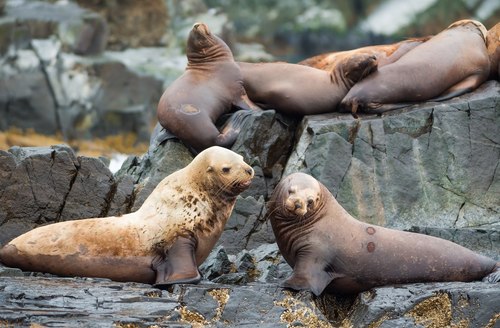
Steller Sea Lion
Eumetopias jubatus
The Steller Sea Lion is the undisputed heavyweight of the North Pacific coastline. With a roar like a lion and the grace of a diver, these massive mammals are a breathtaking sight for any coastal observer.
Quick Identification
Size
Males reach 2.8–3.3 m (9–11 ft) and up to 1,120 kg (2,500 lbs); females reach 2.3–2.9 m (7.5–9.5 ft) and up to 350 kg (770 lbs).
Colors
Tawny to yellowish-brown fur with darker chocolate-brown flippers; males often have a lighter 'mane' of coarse hair.
Key Features
- Blunt, bear-like muzzle with a broad forehead
- External ear flaps (pinnae) on the sides of the head
- Large, hairless front flippers used for propulsion
- Massive, muscular neck on mature males
- Ability to rotate hind flippers forward to 'walk' on land
When You’ll See Them
Behavior
Steller Sea Lions are the giants of the eared seal family, known for their impressive size and thunderous vocalizations. Unlike the playful 'barking' of California Sea Lions, Stellers produce deep, guttural roars that resonate across rocky coastlines. They are highly social animals that gather in large groups at haul-outs to rest, socialize, and sunbathe. Despite their massive bulk, they are surprisingly agile on land, using their powerful flippers to navigate rugged, slippery terrain with ease.
During the breeding season, dominant bulls become extremely territorial, defending stretches of beach to maintain a harem of females. In the water, they are apex predators and highly skilled hunters, often working together to corral schools of fish. While they generally avoid direct human contact, they are curious and may approach boats or docks. Because they are sensitive to disturbance, it is crucial to observe them from a distance to avoid causing a 'stampede' into the water, which can be stressful for the colony.
EverydayEarth exclusive
Camera Tips
Capturing the Steller Sea Lion on a trail camera requires a specialized approach because of their maritime habitat. If you have a coastal property or access to a dock, position your camera at a high vantage point looking down onto rocky 'haul-out' spots. Salt spray is your biggest enemy; ensure your camera housing is weather-sealed and consider applying a hydrophobic spray to the lens cover to prevent water spots from obscuring your shots. Because these animals are massive, you don't need the camera to be low to the ground—mounting it 5-8 feet high on a post or rock face provides the best field of view for a large group.
For those using cameras on docks or piers, focus your lens on the areas where the sea lions climb out of the water. High-speed trigger settings are essential if you want to capture them breaching or splashing, as their movements in the water are incredibly fast compared to their lumbering gait on land. Since they are most active during the day, standard color settings will work best, but ensure your camera has a wide dynamic range to handle the high contrast between dark wet fur and bright, sun-reflective water.
Avoid using traditional lures or bait, as it is often illegal to feed marine mammals and can lead to habituation. Instead, rely on their natural social patterns—they return to the same resting spots daily. Check your local tides; many haul-outs are only accessible to the sea lions during mid-to-high tide, so set your camera's time-lapse mode to trigger more frequently during these windows. Finally, be mindful of the 'marine layer' or fog common in the Pacific Northwest; a camera with a strong infrared flash can help pierce through morning mist if you are capturing early morning arrivals.
Similar Species
Species that look similar or are commonly confused with Steller Sea Lion.
Frequently Asked Questions
Record Steller Sea Lion at your habitat
Connect a camera to start building your own species record — AI identifies every visitor automatically.