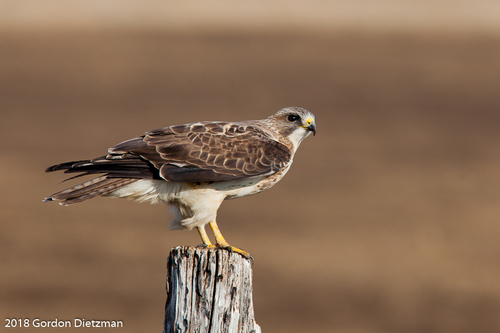
Swainson's Hawk
Buteo swainsoni
The ultimate long-distance traveler of the Great Plains, the Swainson's Hawk is a social raptor known for its striking 'bib' and its surprising appetite for grasshoppers.
Quick Identification
Size
Length: 17–22 in (43–56 cm); Wingspan: 46–54 in (117–137 cm); Weight: 1.1–2.9 lbs (0.5–1.3 kg)
Colors
Highly polymorphic; most common light morphs have a dark brown 'bib' on the chest, white throat, and dark flight feathers contrasting with lighter underwing coverts.
Key Features
- Distinctive dark brown breast band or 'bib'
- Long, pointed wings that reach the tail tip when perched
- Two-toned underwings with dark trailing edges
- White forehead and throat patches
When You’ll See Them
Behavior
Swainson's Hawks are famous for their social nature and incredible migratory journeys. Unlike many other hawks that are solitary, these birds often gather in large groups called 'kettles' during migration, sometimes numbering in the thousands as they travel from the Great Plains all the way to the pampas of Argentina. They are exceptionally graceful in flight, often soaring with their wings held in a slight 'V' shape or dihedral.
During the breeding season, they are territorial but generally more tolerant of human activity than other large raptors, often nesting in isolated trees near agricultural fields. They have earned the nickname 'grasshopper hawk' because of their unique habit of walking along the ground to hunt insects. When they aren't nesting, they switch their diet almost entirely to large insects, often following tractors or livestock to catch the grasshoppers stirred up in the grass.
EverydayEarth exclusive
Camera Tips
To capture high-quality images of a Swainson's Hawk, your best bet is to focus on 'perch-and-pounce' locations. In open prairie or agricultural settings, these hawks rely heavily on fence posts, telephone poles, and isolated snags. Mount your camera on a secondary fence post about 15-20 feet away from a known favorite perch, angling it slightly upward. This allows you to capture the bird's profile and its distinctive 'bib' without the distortion of an ultra-wide lens. If you are using a cellular or AI-powered camera, set it to a high-speed burst mode to catch the moment they take flight, as their wingspan is impressively wide.
A unique strategy for this species involves monitoring 'insect events.' If you have a backyard that borders a field being mowed or harvested, place your camera on a low tripod or a short stake (1-2 feet off the ground) facing the mowed area. Swainson's Hawks are highly opportunistic and will often land on the ground to feast on grasshoppers. A ground-level perspective provides an intimate view of their foraging behavior that most birdwatchers never see. Use a fast shutter speed setting if your camera allows it, as their ground movements can be surprisingly quick.
Seasonality is crucial for placement. During the spring and summer, look for lone trees in the middle of fields—these are prime nesting sites. However, during the late summer and early fall migration (August and September), these hawks congregate. Placing cameras near water sources like stock tanks or shallow ponds during these dry months can result in spectacular group shots, as multiple hawks may land to drink and bathe simultaneously before continuing their long journey south.
For the best lighting, position your camera facing North or South to avoid the direct glare of the rising or setting sun, which can wash out the subtle patterns in their feathers. If your camera has a 'Time Lapse' mode, consider using it during mid-morning when thermals are rising; you might capture the hawks circling as they gain altitude. Avoid using traditional meat-based lures if you want to see their natural 'grasshopper hawk' behavior; instead, simply look for areas with high insect activity or recently disturbed soil.
Similar Species
Species that look similar or are commonly confused with Swainson's Hawk.
Frequently Asked Questions
Record Swainson's Hawk at your habitat
Connect a camera to start building your own species record — AI identifies every visitor automatically.