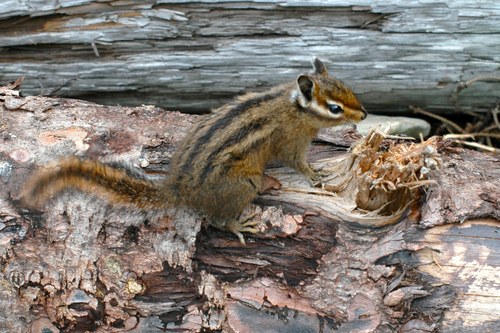
Townsend's Chipmunk
Neotamias townsendii
The largest and most elusive chipmunk of the Pacific Northwest, the Townsend's Chipmunk is a master of the mossy understory. With its dark, shadowy stripes and cautious nature, it is a prized find for any backyard wildlife watcher.
Quick Identification
Size
Total length 23–29 cm (9–11.5 in); weight 60–110 g (2.1–3.9 oz)
Colors
Rich tawny-brown to dark chocolate body; five dark dorsal stripes separated by four lighter, brownish-gray stripes; tawny-orange flanks
Key Features
- Largest chipmunk species in the Pacific Northwest
- Dull, brownish-gray stripes (lacks the bright white of other species)
- Long, bushy tail often held straight during movement
- Large ears compared to other local chipmunks
When You’ll See Them
Behavior
Townsend's chipmunks are the enigmatic giants of the chipmunk world. Unlike their more boisterous and brightly colored cousins found in open meadows, these rodents are specialists of the deep, shadowed forests of the Pacific Northwest. They are primarily ground-dwellers, spending their time scuttling through ferns, salal, and over moss-covered logs. They are notably more cautious and less vocal than other squirrels, often disappearing into thick undergrowth at the first sign of a threat.
While they are solitary and territorial, they maintain complex home ranges that often overlap with abundant food sources. In the garden, they are clever and persistent, often memorizing the exact timing of bird feeder refills. Unlike many other small mammals, they do not enter a deep, continuous hibernation. Instead, they remain semi-active throughout the winter, entering short bouts of torpor and waking frequently to feed on their meticulously gathered food caches during mild weather.
EverydayEarth exclusive
Camera Tips
To capture the Townsend’s chipmunk on camera, you must account for their preference for low-light, high-cover environments. Position your camera in the 'in-between' spaces—near the base of a large Douglas fir, alongside a woodpile, or at the edge of a dense thicket. Set the camera height low, roughly 6 to 10 inches off the ground, and angle it slightly downward. Because these chipmunks move in lightning-fast 'stop-and-go' bursts, a camera with a fast trigger speed (0.3 seconds or less) and a high-frame-rate video mode is essential to catch them before they dart out of frame.
Using a lure is the most effective way to get high-quality close-ups. A small, flat rock or a mossy log placed 3-5 feet in front of the lens serves as a perfect stage. Place a handful of black oil sunflower seeds or raw walnuts in a small crevice on the 'stage' so the animal has to pause and work for the food, giving your AI camera plenty of time to trigger and focus. For the most natural-looking shots, avoid plastic feeders and instead use natural hollows in logs or stumps to hide the bait.
In the Pacific Northwest, rain is a constant factor. Even if your camera is waterproof, a small 'eave' or cover made from a piece of bark can prevent water droplets from blurring the lens. During the summer months, these chipmunks are extremely active in the early morning; however, in the late autumn, you should focus your camera efforts on the warmest part of the afternoon when they are frantically caching food for the winter. If you are using an AI-powered system, ensure the sensitivity is set to 'high' for small animals, as their dark fur can sometimes blend into the forest floor shadows.
Similar Species
Species that look similar or are commonly confused with Townsend's Chipmunk.
Frequently Asked Questions
Record Townsend's Chipmunk at your habitat
Connect a camera to start building your own species record — AI identifies every visitor automatically.