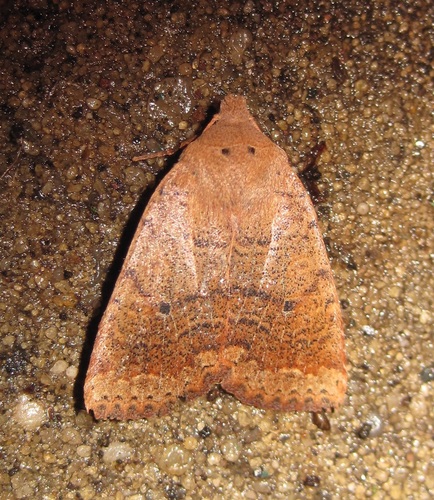
Variable Sallow
Sericaglaea signata
A master of autumn camouflage, the Variable Sallow is one of the few moths you'll spot braving the chilly winter nights. Its stunningly diverse color patterns make it a favorite for backyard naturalists using night-vision cameras.
Quick Identification
Size
Wingspan of 33–42 mm (1.3–1.6 inches)
Colors
Highly variable ranging from pale tan and grayish-brown to deep reddish-orange; usually features a dark-filled kidney-shaped spot on the forewing.
Key Features
- Distinct reniform (kidney-shaped) spot often dark-filled at the bottom
- Smooth, satiny appearance to the forewings
- Subtle, wavy transverse lines across the wings
- Robust, 'furry' thorax typical of owlet moths
When You’ll See Them
Behavior
The Variable Sallow is a remarkably hardy member of the owlet moth family. Unlike many other insects that perish or remain dormant during the colder months, this species is known for its ability to remain active throughout the winter in the southern parts of its range. They are masters of crypsis, blending in perfectly with the dried leaves and autumnal debris found on the forest floor. During the day, they remain motionless in leaf litter, emerging only after the sun sets to seek out energy sources.
These moths are particularly interesting because they overwinter as adults. This means that on unseasonably warm nights in January or February, you might see them fluttering around your porch lights or feeding at sap flows. Their flight is strong and direct, though they spend a significant amount of time crawling on tree trunks or the ground to access food. While they are generally solitary, several individuals may congregate around a single high-quality food source, such as a bleeding tree or a patch of fermented fruit.
EverydayEarth exclusive
Camera Tips
To capture the Variable Sallow on camera, you need to adjust your strategy for 'winter moth' season. Unlike summer moths that flock aggressively to bright white lights, sallows are often more motivated by food than light during the colder months. Set up a 'sugaring' station by painting a mixture of fermented fruit, brown sugar, and a splash of beer onto the trunk of a mature oak or maple tree. Position your camera on a tripod or mount it to a nearby branch about 4 to 5 feet off the ground, focusing specifically on the baited area of the bark.
Because these moths are active when temperatures are low, your camera's battery life will be challenged. If you are using a wireless trail camera, consider an external power pack or solar panel (if it gets enough daytime sun). Set your camera to a macro or close-up mode if available, as these moths are relatively small. A short trigger interval or a 10-second video mode is ideal for capturing them as they crawl across the bark to feed on the sugary bait. Infrared (IR) flashes are excellent for this species because they won't startle the insect, allowing for long observation periods without the moth flying away.
Placement is everything with the Variable Sallow. Look for areas in your yard with plenty of leaf litter, as this is where they hide during the day. If you are using a moth light trap with your camera, try using a UV (blacklight) bulb rather than a standard LED. The UV spectrum is much more attractive to Noctuidae. For the best results, monitor the weather forecast; the best nights for Variable Sallows are those 'thaw' nights where the temperature stays above 40°F (4°C) after dark, especially if there is a light drizzle or high humidity.
Similar Species
Species that look similar or are commonly confused with Variable Sallow.
Frequently Asked Questions
Record Variable Sallow at your habitat
Connect a camera to start building your own species record — AI identifies every visitor automatically.