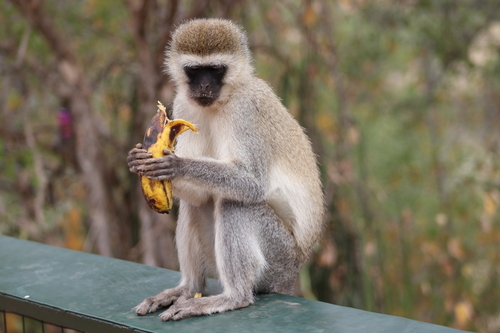
Vervet Monkey
Chlorocebus pygerythrus
Agile, vocal, and incredibly clever, the Vervet Monkey is one of Africa’s most charismatic primates. Whether they are grooming in the shade or performing acrobatic leaps across garden walls, their complex social lives are a fascinating window into the world of wild primates.
Quick Identification
Size
Body length 40-50 cm (16-20 in); weight 3.4-8 kg (7.5-17.6 lbs)
Colors
Silvery-grey fur with a pale underside; black face framed by a white fringe of hair; adult males have a distinctive turquoise-blue scrotum.
Key Features
- Black face with a prominent white brow band
- Long, slender grizzled-grey tail
- Small, rounded ears
- Striking blue scrotum and red penis in adult males
When You’ll See Them
Sightings on EverydayEarth
Aug 1, 2026
A single Vervet Monkey is seen sitting quietly in the grass at the edge of the woodland. It remains mostly stationary, turning its head to scan the environment.
Jul 30, 2026
A group of Vervet Monkeys is active in a grassy woodland clearing. One individual sits prominently in the foreground, looking around and displaying its black face and white forehead band. Further up the slope, other monkeys are seen moving through the brush. Loud, repetitive alarm calls can be heard throughout the sequence.
Jul 30, 2026
An adult Vervet Monkey is seen sitting on a rocky surface with a young infant. The infant moves around actively, eventually climbing onto the adult. Another adult Vervet Monkey enters the scene from the right and begins interacting socially with the pair.
Jul 29, 2026
A troop of Vervet Monkeys is active in the foreground; several individuals are sitting and grooming on a dirt patch while others move through the dry grass. A few small, dark birds are also seen foraging nearby. The scene is set against a backdrop of a quiet watering hole under clear morning light.
Jul 28, 2026
A Vervet Monkey is seen briefly moving across the rocky and debris-covered riverbank on the left side of the frame. It moves with typical primate agility before disappearing into the brush near the water's edge.
Jul 27, 2026
A troop of Vervet Monkeys is foraging across a grassy clearing. They move purposefully through the dry vegetation, occasionally stopping to pick through the ground for food. One individual in the foreground is seen closely examining the earth while others in the background remain alert.
Behavior
They are famous among biologists for their advanced communication system. They use specific alarm calls to warn the troop of different types of predators; for example, a 'leopard' call sends them scurrying into the thin branches of trees, while an 'eagle' call makes them look up and seek cover on the ground. In suburban areas, they have adapted remarkably well, becoming clever 'urban explorers' who can navigate complex neighborhoods using garden walls and rooflines.
EverydayEarth exclusive
Camera Tips
Position your camera to face clear transit routes like flat-topped walls, sturdy horizontal branches, or gaps in hedges. Vervets are creatures of habit and will often follow the exact same path through a garden every day. If you have a birdbath or a shallow water feature, this is an ideal spot for a camera, as the entire troop will often stop for a drink together, providing excellent multi-individual shots. Ensure the sun is behind the camera to avoid 'washing out' their black faces in high-contrast light.
Set your camera to video mode or a high-speed burst of at least 3-5 photos. Vervets move with sudden, jerky movements, and a single still often misses the best action. Since they are strictly diurnal, you can conserve battery and SD card space by using the 'Time Lapse' or 'Timer' function to disable the camera during the night. For the most natural behavior, avoid using food as a lure, which can lead to unnatural aggression; instead, focus on natural attractions like fruiting indigenous trees or water sources.
Similar Species
Species that look similar or are commonly confused with Vervet Monkey.
Frequently Asked Questions
Record Vervet Monkey at your habitat
Connect a camera to start building your own species record — AI identifies every visitor automatically.