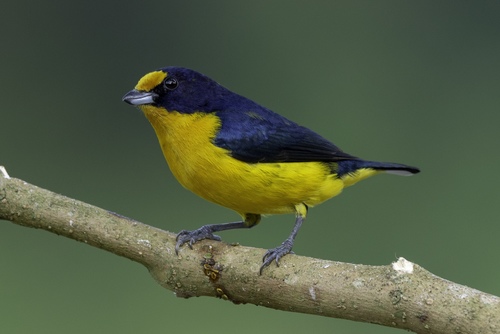
Violaceous Euphonia
Euphonia violacea
A splash of sun-gold and midnight-violet, the Violaceous Euphonia is a master mimic and a jewel of the South American canopy. These tiny but vibrant finches bring a symphony of stolen songs and brilliant color to any backyard bird feeder.
Quick Identification
Size
Length: 4.3 inches (11 cm); Weight: 0.5 oz (14 g)
Colors
Males have iridescent violet-blue upperparts and bright golden-yellow underparts and foreheads; females are dull olive-green above and yellowish below.
Key Features
- Bright yellow forehead patch on males
- Violet-blue iridescent back and wings
- Stubby, dark bill
- Golden-yellow belly and chest
- Short, squared-off tail
When You’ll See Them
Behavior
The Violaceous Euphonia is a social and energetic songbird often found in pairs or small family groups. They are famous for their remarkable vocal mimicry, blending their own high-pitched whistles with the calls of dozens of other bird species to create a complex, continuous stream of song. Despite their small size, they are bold around food sources and can often be seen moving acrobatically through the canopy in search of fruit.
These birds are particularly fond of mistletoe berries and play a crucial role in seed dispersal. While they generally prefer the mid-to-upper canopy, they are curious visitors to garden feeders, especially in areas with mature fruit trees or dense ornamental planting. Their social nature means that if you see one, its mate is likely close by, following a similar foraging path.
EverydayEarth exclusive
Camera Tips
To capture the stunning iridescent blue and gold of the Violaceous Euphonia, camera placement is everything. Since these birds are primarily canopy-dwellers, you’ll have the most success mounting your AI-powered camera near elevated feeding stations or bird baths. Position the camera at a height of 5 to 8 feet, ideally aimed at a horizontal branch or a specialized fruit feeder where they are likely to land and linger. Because of their small size, a close-focus setting or a distance of about 2 to 3 feet from the target perch is ideal for high-detail shots.
Luring them into camera range is best achieved with fruit. They are highly attracted to overripe bananas, papaya, and oranges. Skewer half a banana to a branch or a platform feeder in clear view of the lens. If you live in an area where mistletoe grows, placing your camera near these clusters is a guaranteed way to see them, as it is their favorite food source. Water is also a powerful magnet; a shallow, dripping bird bath or a misting system can draw them down from the high canopy during the heat of the day.
Lighting is crucial for capturing the "violaceous" (violet) sheen on the male's back. Try to position your camera so it faces away from the sun to allow the natural light to hit the bird’s plumage directly, which helps the AI sensor accurately identify the colors. Use a high shutter speed or "motion burst" mode, as Euphonias are incredibly twitchy and fast-moving. Early morning light provides the best color saturation and is when they are most active in their search for breakfast.
Finally, consider the seasonal availability of native fruits in your backyard. During periods when wild fruit is scarce, your backyard feeder will become a high-traffic zone. Keep your camera lenses clean of fruit residue or bird droppings, as these birds can be messy eaters. If using a trail camera, set the trigger interval to the shortest possible time to capture the sequence of their quick, hopping movements as they feed.
Similar Species
Species that look similar or are commonly confused with Violaceous Euphonia.
Thick-billed Euphonia
The Thick-billed Euphonia has a larger yellow crown patch that extends behind the eyes, and a noticeably heavier beak.
Trinidad Euphonia
The Trinidad Euphonia male has a much smaller yellow forehead patch and a more blue-toned back compared to the purple-toned Violaceous.
Purple-throated Euphonia
Unlike the Violaceous, the Purple-throated male has a dark throat that matches its back, rather than a yellow throat.
Frequently Asked Questions
Record Violaceous Euphonia at your habitat
Connect a camera to start building your own species record — AI identifies every visitor automatically.