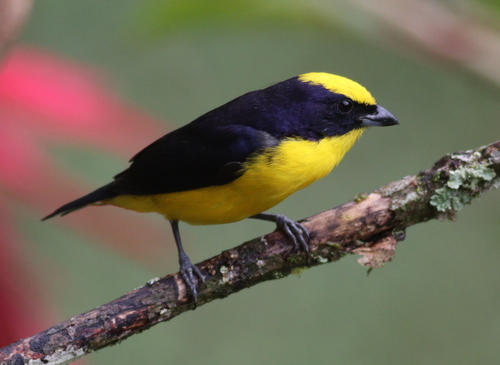
Thick-billed Euphonia
Euphonia laniirostris
A burst of tropical sunshine in bird form, the Thick-billed Euphonia is a master of mimicry and a frequent visitor to backyard fruit feeders. With its stunning blue-black and yellow plumage, this social finch is as much a delight for the eyes as its complex song is for the ears.
Quick Identification
Size
Length: 10–11 cm (4 in); Weight: 13–16.5 g (0.45–0.58 oz)
Colors
Males feature a glossy blue-black upperpart and a bright yellow crown that extends past the eye. Their underparts are entirely vibrant yellow. Females are a duller olive-green on top and yellowish-green on their belly.
Key Features
- Large, heavy-set bill for a small bird
- Male has extensive yellow crown reaching the back of the eye
- Glossy blue-black back and wings on males
- Olive-green upperparts on females
- Frequent 'tail-shivering' movement while perched
When You’ll See Them
Sightings on EverydayEarth
Aug 1, 2026
A female Thick-billed Euphonia hops onto the moss-covered platform from the right side of the frame, pausing briefly to look around before approaching the fruit slices.
Jul 31, 2026
A Palm Tanager is perched on the right side of the feeder tray, occasionally pecking at the fruit. Later, a female Thick-billed Euphonia flies in and lands nearby to feed on the fruit as well.
Jul 29, 2026
A male Thick-billed Euphonia is perched on the feeder tray, actively eating from sliced oranges. In the background, a Blue-gray Tanager perches quietly on a branch to the left of the feeder, observing the surroundings.
Jul 28, 2026
A Crimson-backed Tanager is perched on the feeder tray, actively feeding on a piece of papaya. A second, smaller bird—a male Thick-billed Euphonia—flies in and lands on the opposite side of the tray to join the feeding activity.
Jul 25, 2026
Two male Thick-billed Euphonias are feeding on citrus halves at the fruit feeder. One bird is present at the beginning of the clip, and a second individual joins it after several seconds. Both birds take turns pecking at the fruit pulp before looking around cautiously.
Jul 25, 2026
A female Thick-billed Euphonia is perched on a vine-covered branch just behind the main fruit feeder, looking around the forest environment while staying still.
Behavior
The Thick-billed Euphonia is a charismatic and highly social finch, frequently observed in pairs or small family groups. Unlike many shy forest birds, these euphonias have adapted well to human environments and are a common sight in tropical gardens and suburban edges. They are famously vocal; males are masterful mimics, seamlessly blending the songs and alarm calls of other birds into their own melodic, chirping sequences. If you hear a confusing mix of bird calls coming from a single bush, a Thick-billed Euphonia is likely the culprit.
They are particularly known for their unique relationship with mistletoe. As specialists in eating these berries, they have a simplified digestive tract that allows them to process the fruit quickly. They exhibit a characteristic side-to-side 'wiping' motion on branches to help excrete the sticky seeds, which incidentally helps the mistletoe spread. While they spend much of their time in the mid-to-high canopy, they frequently descend to garden levels for water or soft fruit.
EverydayEarth exclusive
Camera Tips
To capture the best footage of the Thick-billed Euphonia, positioning is everything. Because these birds are quite small, standard trail cameras placed at a distance may miss the fine details of their plumage. Mount your camera between 4 and 7 feet off the ground, ideally facing a frequently used 'staging' branch near a food source. For the sharpest images, ensure your camera's focal range is adjusted for close-up shots (3-5 feet) to highlight the male's glossy blue sheen and the distinctive thick bill that gives them their name.
Attracting them to your camera's field of view is easiest with fruit. Unlike seed-eating finches, euphonias are drawn to 'wet' tropical fruits. A platform feeder or even a simple spike on a tree trunk containing halved bananas, overripe papayas, or oranges will act as a magnet. If you place your camera near such a feeder, set it to 'Burst Mode' or high-speed video. These birds are quick and spend only a few seconds at a time feeding, so a fast trigger speed is essential to catch them before they flit away.
Water is another powerful lure, especially during the dry season. A shallow, elevated birdbath with a small solar-powered dripper will attract euphonias looking to bathe or drink. Position the camera to capture the water surface from a slightly elevated angle. Since the male’s yellow crown and underparts are very bright, try to place the setup in a spot with filtered sunlight or dappled shade; direct, harsh tropical sun can easily overexpose the yellow feathers, making them look like a white blur on digital sensors.
Finally, consider the seasonality of local fruiting trees. If you have a mistletoe infestation in a nearby tree or a fruiting fig, move your camera to those areas. Use a fast shutter speed or a high frame rate (60fps) for video to capture their characteristic 'tail-shivering' and social interactions. Because they often travel in pairs, a wider field of view for your video settings can help you capture the interaction between the male and the olive-green female.
Similar Species
Species that look similar or are commonly confused with Thick-billed Euphonia.
Violaceous Euphonia
The male Violaceous Euphonia has a much smaller yellow patch that only covers the forehead, whereas the Thick-billed's crown extends to the back of the eye.
Yellow-crowned Euphonia
While similar in color, the Yellow-crowned Euphonia has a different range (mostly Central America) and the male's yellow crown is often a slightly different shade and shape.
Frequently Asked Questions
Record Thick-billed Euphonia at your habitat
Connect a camera to start building your own species record — AI identifies every visitor automatically.