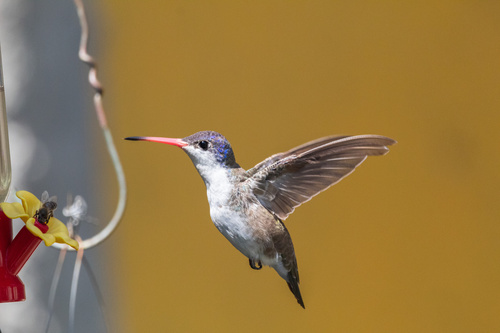
Violet-crowned Hummingbird
Ramosomyia violiceps
Boasting a shimmering sapphire cap and a breast as white as fresh snow, the Violet-crowned Hummingbird is the crown jewel of the desert Southwest. This elegant visitor brings a touch of tropical brilliance to riparian canyons and lucky backyard gardens alike.
Quick Identification
Size
Approximately 10 cm (3.9 in) in length with a 13-15 cm (5.1-5.9 in) wingspan; weighs between 5 and 5.8 grams (0.18–0.20 oz).
Colors
Distinctive violet-blue crown; brilliant snow-white throat and underparts; bronze-green back; bright red bill with a black tip.
Key Features
- Shimmering violet-blue crown
- Pristine white underparts from chin to tail
- Bright reddish bill with a dark tip
- Large size for a hummingbird
- Bronze-green upperparts
When You’ll See Them
Geographic range
Where Does the Violet-crowned Hummingbird Live?
The Violet-crowned Hummingbird is a North American native predominantly found throughout Western and Central Mexico, where it remains a year-round resident. During the spring and summer months, its range extends northward into the 'sky islands' of southeastern Arizona and southwestern New Mexico in the United States, making it a sought-after specialty for birders in the borderlands. While most populations stay south of the border, they are occasionally spotted as vagrants as far north as California.
Basemap © OpenStreetMap contributors
Behavior
The Violet-crowned Hummingbird is a bold and often territorial species, particularly when defending preferred nectar sources in its riparian habitats. Unlike many other hummingbirds, it lacks the iridescent throat gorget typical of the family, instead relying on its starkly contrasting white breast and vibrant crown to signal its presence. It is known for its steady, direct flight and its tendency to perch on high, exposed branches between foraging bouts to keep watch over its territory.
During the breeding season, these birds are typically found in sycamore-lined canyons, where females construct high, cup-shaped nests using plant down and lichen. While they can be wary of human activity, they are frequent and welcome visitors to backyard feeders in the American Southwest, where they often dominate smaller hummingbird species through sheer size and persistent vocalizations.
EverydayEarth exclusive
Camera Tips
To capture the shimmering violet crown of this species, camera placement is critical. Mount your AI-powered camera within 2 to 3 feet of a hummingbird feeder or a cluster of native tubular flowers like Salvia. Positioning the lens at a slightly upward angle, roughly 4 to 5 feet off the ground, will help you document the distinctive red-and-black bill and the bright white underparts that are the hallmarks of this species.
Lighting is the greatest challenge because these birds often inhabit shaded canyons. Position your camera so the morning or late-afternoon sun hits the bird's crown from behind the camera; this 'angle of incidence' is what makes the violet feathers glow. If your camera settings allow, use a high shutter speed or a 60fps video mode to freeze the rapid wing motion and capture the detail of the bird’s bronze-green tail feathers.
Attract them consistently by using a clear nectar solution (four parts water to one part white sugar) and avoiding red dyes, which are unnecessary and potentially harmful. Because Violet-crowned Hummingbirds are larger and more aggressive than common species like the Black-chinned, they may chase others away. Setting up a secondary camera at a different feeder several yards away can help you capture more varied behavior and social interactions.
In the United States, focus your camera efforts during the peak migration window from June through August. Ensure your camera is set to its highest sensitivity for motion detection, as hummingbirds move with incredible speed. If your device supports AI species recognition, check that it is updated to identify southwestern specialties, as the stark white belly is a primary visual trigger for identification against darker foliage.
Similar Species
Species that look similar or are commonly confused with Violet-crowned Hummingbird.
Broad-billed Hummingbird
Features a dark blue-green throat and belly, whereas the Violet-crowned is famous for its stark, clean white underparts.
White-bellied Hummingbird
Found in South America; it shares the white underparts but lacks the distinct reddish bill and vibrant violet crown of the Ramosomyia species.
Azure-crowned Hummingbird
Native to Central America; it has a duller blue crown and less brilliant white on its breast compared to the Violet-crowned.
Frequently Asked Questions
Record Violet-crowned Hummingbird at your habitat
Connect a camera to start building your own species record — AI identifies every visitor automatically.