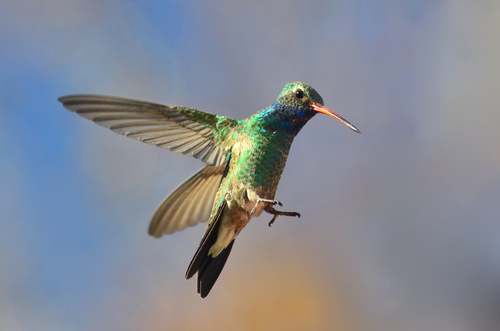
Broad-billed Hummingbird
Cynanthus latirostris
A shimmering jewel of the desert, the Broad-billed Hummingbird captivates with its brilliant sapphire throat and signature scarlet bill. This bold, energetic visitor is a favorite for backyard observers across the American Southwest and Mexico.
Quick Identification
Size
Length: 9–10 cm (3.5–4 in); Wingspan: 13 cm (5.1 in); Weight: 3–4 g (0.1 oz)
Colors
Males feature iridescent emerald green bodies and vibrant sapphire-blue throats; females are muted grey-green with a distinct white stripe behind the eye. Both sexes possess a signature bright red bill with a black tip.
Key Features
- Broad, bright red bill with a black tip
- Iridescent blue-green plumage (males) or pale grey underparts (females)
- Deeply forked, dark tail
- White 'eyebrow' stripe prominent in females and juveniles
When You’ll See Them
Sightings on EverydayEarth
May 13, 2026
A male Broad-billed Hummingbird perches on the rim of a red nectar feeder. It frequently dips its bill into the feeding ports to drink and pauses to scan the surroundings, showing off its vibrant blue and green plumage.
Geographic range
Where Does the Broad-billed Hummingbird Live?
Native to North America, the Broad-billed Hummingbird is primarily a resident of Mexico, where it is widely distributed across the central and western highlands. Its range extends northward into the southwestern United States, with significant breeding populations found in the mountain canyons and river valleys of southern Arizona and New Mexico. While many populations in Mexico stay put year-round, those in the northernmost reaches are migratory, heading south into warmer Mexican states during the winter months.
Basemap © OpenStreetMap contributors
Behavior
The Broad-billed Hummingbird is a high-energy aerial acrobat known for its bold and inquisitive nature. Unlike some of its more skittish relatives, this species is often quite comfortable around humans, frequently visiting backyard feeders even while people are nearby. They are highly territorial, especially males, who will aggressively defend a preferred patch of flowers or a feeder from other hummingbirds with rapid, darting dives and chattering vocalizations.
During the day, they spend their time 'trap-lining'—visiting a series of nectar sources in a specific circuit—or hovering expertly to glean small insects from mid-air or foliage. While they are most active from dawn until dusk, they may enter a state of torpor during particularly cold desert nights to conserve energy, significantly lowering their body temperature and heart rate.
EverydayEarth exclusive
Camera Tips
To capture the stunning iridescence of a Broad-billed Hummingbird, camera placement is everything. Position your AI-powered camera within 18 to 24 inches of a nectar feeder or a cluster of native tubular flowers like Desert Honeysuckle or Agave. Because these birds move with incredible speed, ensure your camera is set to its highest possible shutter speed or 'action' mode to freeze the wing motion, which can exceed 50 beats per second.
Lighting is the 'secret sauce' for this species. Try to angle your camera so the sun is behind you, illuminating the bird's front. This allows the light to hit the microscopic structures of the feathers, revealing the brilliant sapphire blue of the male's throat. Side-lighting can also create a dramatic effect, highlighting the unique shape of the broad, red bill. Avoid placing cameras in deep shade, as the bird will appear as a dark, indistinct silhouette.
For the best variety of shots, place your camera near a 'perching twig' about three to five feet away from a feeder. Hummingbirds often stop to rest and survey their territory between feedings. A camera aimed at a favorite perch will capture more detailed, still portraits than one aimed only at a moving feeder. If using a trail camera, ensure it has a fast 'trigger speed' to catch the bird before it zips out of the frame.
Similar Species
Species that look similar or are commonly confused with Broad-billed Hummingbird.
White-eared Hummingbird
Features a much more prominent, thick white ear-stripe and a purple-tinted crown.
Violet-crowned Hummingbird
Has a pure white underbelly and a bright violet-blue cap, lacking the green chest of the Broad-billed.
Black-chinned Hummingbird
Lacks the red bill entirely, featuring a dark bill and a black throat with a thin purple band.
Frequently Asked Questions
Record Broad-billed Hummingbird at your habitat
Connect a camera to start building your own species record — AI identifies every visitor automatically.