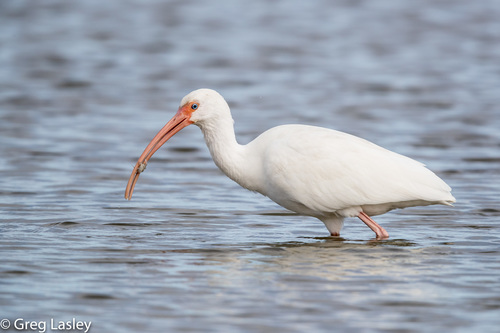
White Ibis
Eudocimus albus
With their striking curved red bills and snow-white feathers, White Ibises are the elegant "lawn mowers" of the American South. Often seen in social groups, these charismatic waders bring a touch of coastal charm right into your backyard.
Quick Identification
Size
Length: 21–28 in (53–71 cm); Wingspan: 35–41 in (90–105 cm); Weight: 1.6–2.7 lbs (750–1200 g)
Colors
Adults are pure white with black wingtips; juveniles are mottled brown and white. Both feature vibrant red-orange bills and legs.
Key Features
- Long, downward-curving red-orange bill
- Bright white plumage with black-tipped wings
- Reddish facial skin and long orange-red legs
- Medium-sized wader often found in groups
When You’ll See Them
Sightings on EverydayEarth
Jul 21, 2026
Several White Ibises are perched and roosting in the dense branches of a tree at night. The birds are mostly stationary, resting with their heads tucked into their feathers, while the infrared camera highlights their bright plumage against the dark foliage.
Jul 21, 2026
A group of White Ibises are seen roosting in the branches of a tree at night. One bird in the upper portion of the frame is particularly active, shifting its weight and turning its head, which clearly displays its long, downward-curved bill. Other birds are visible perched lower in the foliage.
Jul 20, 2026
A group of wading birds is seen roosting in a tree during the night. A Black-crowned Night Heron is perched higher up in a hunched position, while several White Ibises are gathered on the lower branches. The birds remain mostly stationary, occasionally shifting their weight or turning their heads.
Jul 15, 2026
Several wading birds are roosting in the branches of a tree at night. A White Ibis is perched prominently in the center of the frame, occasionally adjusting its position and turning its head, while other birds are visible further back in the foliage.
Jul 14, 2026
In the quiet of night, several wading birds are roosting together in the branches of a cypress tree. Multiple White Ibis are visible, identifiable by their long, curved bills as they occasionally shift and groom. Perched to the left is a Black-crowned Night Heron, sitting in a typical compact, hunched position. The birds remain relatively still, occasionally turning their heads in the darkness.
Jul 13, 2026
A diverse group of wading birds is gathered on a muddy bank at the water's edge. Several White Ibises and Glossy Ibises are actively probing the soft ground for food with their long, curved bills. A Tricolored Heron stands patiently near the water, while a Snowy Egret observes from the left. The birds move calmly through the shallow water and across the bank.
Behavior
White Ibises are highly social birds that are rarely seen alone. They spend much of their day foraging in large groups, often called "parliaments," probing the soil or mud with their specialized, sensitive bills. In suburban environments, they have become remarkably bold, often marching across manicured lawns or parks in search of insects and crustaceans. They are tactile feeders, meaning they find food by touch rather than sight, rapidly opening and closing their bills as they probe deep into the earth.
While they are strong fliers often seen moving in V-formations, they are most frequently observed walking with a steady, purposeful gait. They are colonial nesters, forming massive colonies in trees or shrubs over water for protection. To humans, they are generally tolerant and can become quite habituated to backyard activity, though they will flush if approached too quickly. Their presence is often announced by a series of low, nasal croaks during flight or while feeding.
EverydayEarth exclusive
Camera Tips
To capture the perfect shot of a White Ibis, position your camera low to the ground—about 12 to 18 inches high. Because these birds spend most of their time probing the grass or mud, a low angle provides a more intimate "eye-level" perspective of their unique foraging behavior. Aim the camera toward damp patches of lawn or near the edges of garden ponds where they are most likely to hunt for grubs or crayfish. If you have a birdbath, ensure it is a ground-level basin, as ibises are less likely to use elevated pedestals.
The White Ibis’s bright white plumage presents a significant challenge for AI-powered cameras: overexposure. To avoid "blown-out" highlights where the bird looks like a glowing white blob, try to place your camera in a spot that receives dappled sunlight or consistent shade during the peak morning hours. If your camera settings allow for exposure compensation, dialing it down by -0.5 or -1.0 can help preserve the texture of their feathers. Avoid placing the camera where it faces directly into the rising or setting sun, as the backlighting will turn the bird into a dark silhouette.
While we don't recommend traditional birdseed, you can attract White Ibises by keeping your lawn well-watered. A damp lawn brings soil invertebrates like earthworms and beetle larvae to the surface, which is a natural "bait" for these birds. If you have a large property with a water feature, placing the camera on a tripod near the muddy shoreline is the gold standard for high-quality captures. Set your trigger interval to "short" or "burst mode" because ibises move their heads rapidly while probing, and you'll want multiple frames to ensure at least one has the bill in a sharp, visible position.
Seasonally, keep an eye out during the late summer when "brown" juveniles begin to forage with the adults. These younger birds provide great visual variety for your camera feed and are often more curious than the adults. During the winter months in Florida and the Gulf Coast, ibises may congregate in even larger numbers, so wide-angle lenses are preferred to capture the whole flock. Finally, ensure your lens is clean; their probing behavior often splashes mud or water, which can quickly obscure the view of a low-mounted camera.
Similar Species
Species that look similar or are commonly confused with White Ibis.
Wood Stork
Much larger with a bald, scaly gray head and a thicker, less-curved bill.
Snowy Egret
Possesses a straight black bill and distinctive yellow feet, lacking the Ibis's curved red bill.
Glossy Ibis
Similar shape and bill, but features dark, iridescent bronze and violet plumage instead of white.
Frequently Asked Questions
Record White Ibis at your habitat
Connect a camera to start building your own species record — AI identifies every visitor automatically.