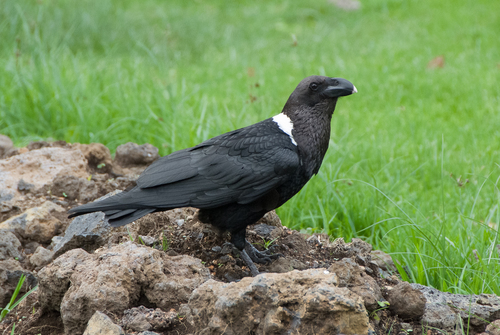
White-necked Raven
Corvus albicollis
The White-necked Raven is the brilliant strategist of the African skies. Recognized by its massive bill and striking white collar, this highly intelligent bird turns every backyard visit into a display of aerial grace and curiosity.
Quick Identification
Size
Length: 50–54 cm (20–21 in); Wingspan: 80–100 cm (31–39 in); Weight: 760–1160 g (1.7–2.6 lbs)
Colors
Lustrous black body with a distinct white patch on the lower nape; black bill with a white or pale tip.
Key Features
- Massive, arched bill with a pale tip
- Prominent white patch on the back of the neck
- Relatively short, square-ended tail
- Large, robust body smaller than a Common Raven but larger than a crow
When You’ll See Them
Behavior
White-necked Ravens are remarkably intelligent and social birds, usually seen in pairs or small family groups. They are known for their playful and acrobatic flight displays, often soaring on thermals near cliffs or high buildings. These birds are highly opportunistic and have adapted well to human presence, frequently patrolling campsites and suburban gardens for easy meals.
In the wild, they exhibit complex problem-solving skills, such as dropping hard-shelled prey like tortoises or bones onto rocks from a height to break them open. They are vocal birds, possessing a deep, guttural croak that is higher pitched than the Common Raven but significantly deeper than a typical crow. While they can be wary, their curiosity often leads them to investigate new objects in their territory.
EverydayEarth exclusive
Camera Tips
To capture high-quality footage of White-necked Ravens, focus your camera placement on elevated structures. These birds are natural 'lookouts' and prefer landing on roof peaks, chimney stacks, or high fence posts where they have a clear view of the surrounding area. If you are using a pole-mounted camera, ensure it is at least 6-8 feet off the ground. Angle the lens slightly upward if the bird is likely to land on a high perch, or use a wide-angle lens to capture their impressive wingspan as they swoop in.
Because they are incredibly intelligent, these ravens may notice a new camera quickly. To avoid 'camera shyness,' mount your equipment and leave it in place for several days before expecting natural behavior. For baiting, these birds are highly attracted to high-protein items. A small amount of unsalted suet, raw meat scraps, or even a handful of dry dog kibble placed on a flat, elevated platform will almost certainly draw their attention. Ensure the bait is secured or placed in a way that forces the bird to stay in the frame to consume it.
Settings are crucial for ravens due to their dark plumage. Use a camera with a high dynamic range (HDR) to prevent the black feathers from appearing as a featureless silhouette against a bright sky. Set your trigger speed to the fastest possible setting—ideally sub-0.5 seconds—as they are quick to land and take off. If your camera supports 'burst mode,' set it to take 3-5 photos per trigger to capture the subtle head tilts and expressions that define their character.
Lastly, consider the sun's position. Because of their glossy black feathers, direct midday sun can cause harsh glints. Positioning your camera to face north or south (in the southern hemisphere) will provide more even, diffused lighting during the early morning and late afternoon 'golden hours' when they are most active. In suburban settings, they are most active just after sunrise before human foot traffic peaks, so ensure your camera's schedule is active at first light.
Similar Species
Species that look similar or are commonly confused with White-necked Raven.
Pied Crow
The Pied Crow has a much larger area of white covering its entire breast and belly, whereas the raven only has a white nape patch.
Cape Crow
The Cape Crow is entirely black with a much thinner, more pointed bill and lacks the white neck patch and white bill tip.
Thick-billed Raven
Found further north in Ethiopia, it is significantly larger with an even more massive, deeply ridged bill.
Frequently Asked Questions
Record White-necked Raven at your habitat
Connect a camera to start building your own species record — AI identifies every visitor automatically.