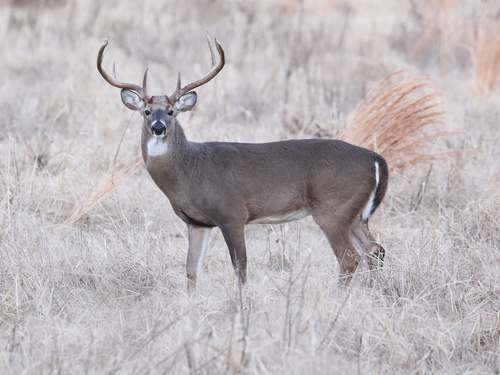
White-tailed Deer
Odocoileus virginianus
The White-tailed deer is a graceful icon of the American landscape, known for its incredible speed and the flash of its namesake white tail. Highly adaptable and surprisingly elusive, these 'ghosts of the forest' are a rewarding challenge for any backyard wildlife enthusiast.
Quick Identification
Size
Length: 37–87 in (95–220 cm); Shoulder height: 21–47 in (53–120 cm); Weight: 90–300 lbs (40–135 kg)
Colors
Reddish-brown in summer and grayish-brown in winter; white underside of tail; white throat patch and rings around eyes.
Key Features
- Distinctive white underside of the tail held erect when alarmed
- Branched antlers on males (bucks) that curve forward
- Large, dark eyes with white rings
- White 'bib' on the throat and white belly
When You’ll See Them
Sightings on EverydayEarth
Jun 5, 2026
An adult white-tailed deer doe stands in a wooded clearing, attentively grooming her small, spotted fawn. The morning light filters through the trees as the mother licks the fawn's neck and head. After a brief moment of care, the pair begins to wander off into the surrounding greenery.
Jun 4, 2026
An Eastern Fox Squirrel hops across the clearing from left to right, while a White-tailed Deer stands alert at the edge of the woods on the right, watching the surroundings.
Jun 23, 2026
A buck with antlers in velvet walks into the clearing, pauses to look toward the camera, and then approaches for a close-up before continuing on his way.
Apr 23, 2026
A pair of White-Tailed Deer and a Wild Turkey share a quiet morning in a wooded clearing. One deer stands alert on the left while another is visible further back in the trees. In the center, the turkey moves along a fallen log, foraging through the leaf litter.
Jun 24, 2026
Three white-tailed deer are active in the woodland clearing during the evening. One deer enters from the left and begins grazing, while another is already visible in the background foraging. A third deer remains partially obscured by the trees on the far right. They move calmly through the lush vegetation, occasionally flicking their tails and looking around.
Jul 30, 2026
A group of five white-tailed deer is active along a woodland trail. Two spotted fawns and two adults graze in the background, while a curious doe approaches the camera for a close inspection. The inquisitive deer sniffs and licks the lens, providing a detailed view of its face, ears, and snout before moving off to the side.
Behavior
White-tailed deer are highly social and intelligent mammals known for their extreme agility and wariness. They typically live in small family groups led by a matriarchal doe, while adult bucks often live solitarily or in small bachelor groups for most of the year. Their most famous behavior is 'flagging'—raising their broad tail to reveal the bright white underside as a warning signal to other deer when a predator is detected.
These deer are masters of the 'edge' environment, frequently utilizing the border between deep woods and open clearings. They have adapted remarkably well to human presence, often treating suburban gardens as high-quality foraging grounds. During the autumn breeding season, known as the 'rut,' their behavior changes drastically; bucks become much more active, territorial, and bold as they seek out mates.
EverydayEarth exclusive
Camera Tips
To successfully capture White-tailed deer on your EverydayEarth camera, location is everything. Look for 'runs' or 'deer trails'—narrow, well-worn paths that lead from dense cover to open feeding areas. Place your camera about 3 to 4 feet off the ground, roughly at the chest height of an adult deer. Angle the camera slightly downward to ensure you capture fawns as well as large bucks. Avoid pointing the lens directly east or west to prevent the rising or setting sun from washing out your footage during their peak activity hours.
Using a 'station' approach can yield great results. If local regulations allow, a salt lick or a specialized mineral block can act as a consistent magnet for deer, encouraging them to pause and linger in front of the lens. In a backyard setting, placing the camera near favorite food sources like hostas, apple trees, or bird feeders (which they will often raid) is an excellent strategy. During the winter months, focus on evergreen patches where deer seek shelter from the wind and snow.
For the best technical results, use a fast trigger speed (0.5 seconds or less) and set your camera to capture short video clips (10-20 seconds). Deer are often followed by others, so a 'trigger interval' of zero or five seconds will help you capture the whole family group rather than just the lead doe. In the autumn, keep an eye out for 'scrapes'—patches of bare earth where bucks have cleared away leaves and urinated to mark their territory; a camera placed over a fresh scrape is almost guaranteed to capture buck activity.
Similar Species
Species that look similar or are commonly confused with White-tailed Deer.
Frequently Asked Questions
Record White-tailed Deer at your habitat
Connect a camera to start building your own species record — AI identifies every visitor automatically.