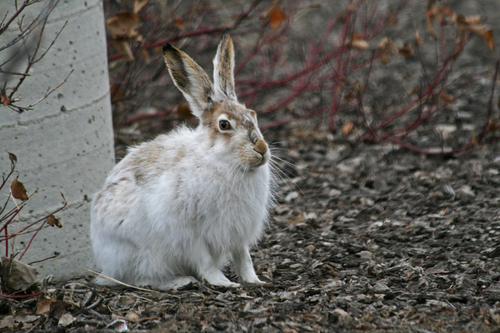
White-tailed Jackrabbit
Lepus townsendii
The White-tailed Jackrabbit is the heavyweight champion of the prairie, capable of outrunning predators with 40-mph sprints and 15-foot leaps. Witness this elusive speedster as it transitions from a summer coat of dusty brown to a winter coat of snowy white.
Quick Identification
Size
22–26 inches (56–66 cm) in length; 5.5–10 lbs (2.5–4.5 kg)
Colors
Brownish-gray upperparts with a white belly; distinctive all-white tail; ears have black tips and white edges; winter coat turns white in northern latitudes.
Key Features
- Oversized ears with black-fringed tips
- Distinctive white tail, white on both top and bottom
- Powerful hind legs significantly longer than front legs
- Seasonal color change from grayish-brown to white in snowy regions
When You’ll See Them
Behavior
During the breeding season, their solitary nature shifts briefly. You might see groups of males engaged in 'boxing' matches or leaping over one another to impress a female. While they are naturally wary of humans, they have adapted well to suburban fringes and agricultural areas where food is plentiful, though they remain much more elusive than the common Eastern Cottontail.
EverydayEarth exclusive
Camera Tips
Since they are most active during the low-light hours of dusk and dawn, a camera with a high-quality infrared sensor is essential. White-tailed Jackrabbits can be 'camera shy' if they detect the faint red glow of standard IR LEDs, so if you have a 'no-glow' or 'black IR' model, use it here. Set your camera to a fast trigger speed (0.3 seconds or less) and use a multi-shot burst mode. These animals move with sudden, powerful leaps, and a single-shot setting often results in a photo of a disappearing tail.
If you are trying to attract them to a specific spot, a small mineral or salt lick placed near a patch of clover is highly effective, especially in the heat of summer. In winter, they are often drawn to the fallen twigs of fruit trees or accessible shrubs. If you live in a northern area where they turn white in winter, try to angle your camera toward a dark backdrop like a dense hedge or a dark-colored shed. This provides the contrast needed for the camera's motion sensor to trigger effectively and makes the white-on-white image much clearer to see.
Similar Species
Species that look similar or are commonly confused with White-tailed Jackrabbit.
Black-tailed Jackrabbit
Features a black stripe on the top of the tail and slightly larger ears; does not turn white in winter.
Snowshoe Hare
Much smaller with shorter ears; prefers dense forest cover over open prairies; has significantly larger, 'furry' hind feet.
Mountain Cottontail
Smaller body size with much shorter ears and a puffier, cotton-like tail; lacks the black ear tips of the jackrabbit.
Frequently Asked Questions
Record White-tailed Jackrabbit at your habitat
Connect a camera to start building your own species record — AI identifies every visitor automatically.