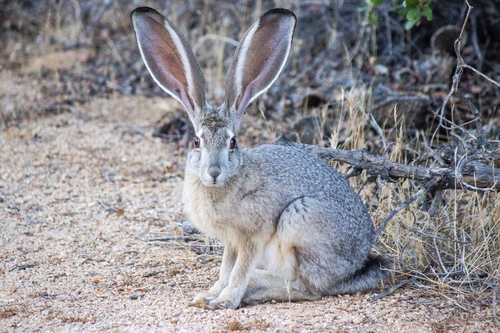
Black-tailed Jackrabbit
Lepus californicus
With ears that act like natural cooling systems and legs built for 40-mph sprints, the Black-tailed Jackrabbit is an icon of the American West. These resilient hares are masters of the open desert, blending perfectly into the sagebrush until they take to the air in a spectacular display of speed.
Quick Identification
Size
Length: 18-24 in (46-61 cm); Weight: 3-6 lb (1.4-2.7 kg)
Colors
Buff-gray and black agouti fur above with a white belly; distinctive black-tipped ears and a black stripe running from the tail onto the rump.
Key Features
- Oversized ears measuring up to 7 inches with prominent black tips
- Long, powerful hind legs built for speeds up to 40 mph
- Distinctive black dorsal stripe extending from the rump to the tail
- Large amber-colored eyes positioned on the sides of the head for near 360-degree vision
When You’ll See Them
Sightings on EverydayEarth
Apr 1, 2026
During the night, a Black-tailed Jackrabbit is seen grooming its face on a grassy bank before hopping out of view. The footage then transitions to a daytime scene showing a dense concentration of waterfowl, including Northern Pintails and Northern Shovelers, active in a large marshy wetland.
Geographic range
Where Does the Black-tailed Jackrabbit Live?
The Black-tailed Jackrabbit is native to the North American continent, holding a massive territory that spans the western half of the United States and much of central and northern Mexico. Its core range extends from the Pacific coast through the Great Basin and across the Great Plains, occasionally reaching as far east as Missouri. This adaptable species has also established introduced populations in parts of Florida and the Northeast, demonstrating its ability to thrive in various temperate and arid environments.
Basemap © OpenStreetMap contributors
Behavior
Black-tailed Jackrabbits are masters of the high-speed escape. Unlike their cottontail cousins that dive into burrows, these hares rely on their incredible athleticism to outrun predators, reaching speeds of 40 miles per hour and leaping over 20 feet in a single bound. They are mostly crepuscular, meaning they are busiest during the twilight hours of dawn and dusk, though they can often be seen foraging on moonlit nights.
As true hares, they do not dig burrows. Instead, they rest in 'forms'—shallow depressions in the ground or under the shade of a shrub—where they use their massive ears to dissipate heat. While generally solitary, they may gather in small, loose groups where food is abundant. Their social interactions are usually limited to brief displays of dominance or during the breeding season when 'boxing' matches between competing males occur.
EverydayEarth exclusive
Camera Tips
To capture high-quality footage of a Black-tailed Jackrabbit, camera placement is everything. Since these hares are low to the ground and move along established 'runs' through the brush, mount your camera no higher than 12 to 18 inches off the ground. Aiming the lens parallel to the trail rather than directly across it will give the sensor more time to trigger before the hare zips out of frame. Use a wide-angle setting if available to capture their impressive leaps.
In arid backyard settings, water is the ultimate draw. A low-profile birdbath or a simple shallow dish of water placed in an open area near cover will frequently attract jackrabbits, especially during the heat of the summer. Avoid using heavy scents or food baits, as these are more likely to attract predators like coyotes or foxes, which will keep the jackrabbits away. Instead, focus on natural corridors between dense shrubs and open feeding grounds.
Because jackrabbits are incredibly fast, your camera settings need to be optimized for motion. Set your trigger speed to the fastest possible interval (0.2 seconds or less is ideal) and use a high frame rate for video. If your camera has a 'burst' mode for photos, enable it to capture the sequence of their movement. Since they are most active in low light, ensure your camera has a high-quality infrared flash that won't spook them, as white light flashes may cause them to flee the area permanently.
Seasonal timing also plays a role in successful captures. During the spring breeding season, jackrabbits are more active during the daylight hours and engage in social behaviors like 'boxing.' During this time, look for flat, open 'arenas' in your yard where the ground is slightly cleared. Placing a camera here can yield fascinating footage of their complex social hierarchy and energetic mating displays.
Similar Species
Species that look similar or are commonly confused with Black-tailed Jackrabbit.
Frequently Asked Questions
Record Black-tailed Jackrabbit at your habitat
Connect a camera to start building your own species record — AI identifies every visitor automatically.