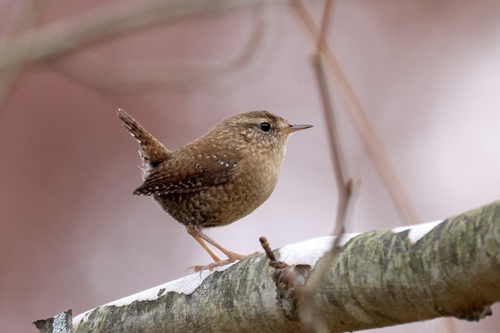
Winter Wren
Troglodytes hiemalis
The Winter Wren is a tiny, feathered dynamo that brings a powerful voice to the forest floor. Often seen scurrying like a mouse through the shadows, this secretive bird is a treat for any backyard observer lucky enough to spot one.
Quick Identification
Size
Length: 3.1–4.7 in (8–12 cm); Wingspan: 4.7–6.3 in (12–16 cm); Weight: 0.3–0.4 oz (8–12 g)
Colors
Rich reddish-brown upperparts with heavy dark brown barring on the wings, tail, and belly; pale tan or buffy 'eyebrow' line above the eye.
Key Features
- Tiny, round body with a very short tail often held upright
- Heavy dark barring across the belly and flanks
- Secretive, mouse-like movements through dense cover
- Thin, sharply pointed bill for extracting insects
When You’ll See Them
Behavior
The Winter Wren is often described as more mouse-like than bird-like. It spends the vast majority of its time staying low to the ground, hopping through tangled roots, fallen logs, and dense brush. It is a highly energetic bird, constantly bobbing its body and flicking its wings as it explores every crevice for food. Despite its tiny size, the Winter Wren possesses one of the most powerful and complex songs in the bird world, consisting of a long, cascading series of trills that can be heard from a significant distance.
Unlike many other backyard birds, Winter Wrens are quite shy and rarely venture into open spaces. They prefer the security of deep shadows and thick vegetation. While they are mostly solitary, they have a fascinating winter survival strategy where multiple individuals may huddle together in a single nest box or tree cavity to share body heat during freezing nights. In a backyard setting, you are more likely to hear their 'check-check' alarm call before you actually see them.
EverydayEarth exclusive
Camera Tips
To successfully capture a Winter Wren on your AI camera, you must change your perspective. These birds rarely fly high; they 'scuttle' along the ground. Mount your camera no more than 6 to 12 inches off the ground, ideally aiming it at a mossy log, the base of a stump, or the entrance to a brush pile. Because they are so small and move with lightning-fast, erratic hops, a camera with a high-speed trigger (under 0.3 seconds) is a must. If your camera allows for it, use 'Burst Mode' to capture a sequence of shots, as they rarely stay still for more than a second.
Winter Wrens are highly attracted to moving water, but they prefer it at ground level. Placing your camera near a low-profile birdbath with a 'dripper' or a small backyard stream is your best chance for a clear, centered photo. Unlike chickadees or finches, they won't come to a hanging seed feeder. Instead, try placing a few dried mealworms inside a hollowed-out log or underneath a propped-up piece of bark within the camera's field of view. This mimics their natural foraging behavior and encourages them to linger long enough for the AI to identify them.
Placement is everything. Avoid sunny, open patches of lawn. Position your camera in the 'edge' zones of your yard—where the garden meets the woods or under the canopy of low-hanging evergreens. Because of their dark brown plumage, they can blend into the shadows; setting your camera to a higher PIR (Passive Infrared) sensitivity will help the sensor detect their small heat signature against the cool forest floor. During the winter, keep your camera pointed at any dense woodpiles, as these serve as both hunting grounds and nightly shelters for the wrens.
Similar Species
Species that look similar or are commonly confused with Winter Wren.
Frequently Asked Questions
Record Winter Wren at your habitat
Connect a camera to start building your own species record — AI identifies every visitor automatically.