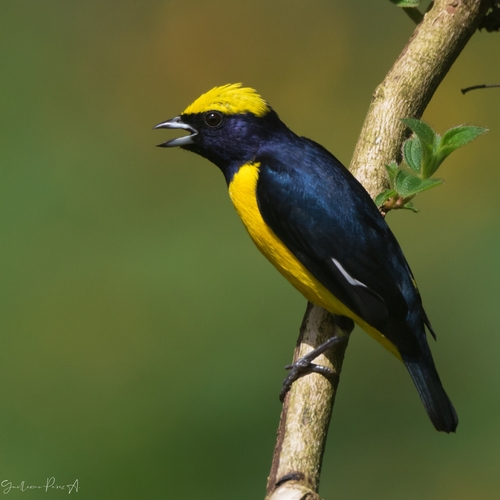
Yellow-crowned Euphonia
Euphonia luteicapilla
Meet the Yellow-crowned Euphonia, a tiny, vibrant songbird that brings a flash of gold to the tropical canopies of Central America. Though small in stature, these energetic fruit-eaters are a delight to spot on backyard cameras thanks to their bold colors and social nature.
Quick Identification
Size
Length: 9-11 cm (3.5-4.3 in); Weight: 10-14 g (0.35-0.5 oz)
Colors
Males are glossy blue-black above with a bright yellow crown patch and belly; females are olive-green above and dull yellow below.
Key Features
- Bright yellow forehead and crown on males
- Glossy blue-black throat and upperparts
- Small, stubby bill typical of euphonias
- Yellow underparts from breast to tail
When You’ll See Them
Behavior
The Yellow-crowned Euphonia is a tireless bundle of energy, often seen flitting through the mid-to-upper canopy in search of its favorite treats. Unlike many forest birds that stay hidden in the shadows, these social finch-like birds are quite active and are frequently found in pairs or small family groups. They have a distinctive, repetitive calling pattern that often alerts birdwatchers to their presence before they are even seen.
These birds have a fascinating relationship with mistletoe. They are specialized foragers that have evolved a simplified digestive tract to process mistletoe berries quickly. After eating the fruit, they wipe their vents on branches to pass the sticky seeds, effectively planting new mistletoe plants. While they are generally peaceful, they can be quite vocal when defending a particularly juicy patch of fruit from other small birds.
EverydayEarth exclusive
Camera Tips
Capturing the Yellow-crowned Euphonia on camera requires a bit of vertical thinking. Because these birds prefer the canopy and mid-story, a camera placed at eye level in an open field likely won't see much action. Instead, look for native fruiting trees or mistletoe clumps. Mounting your camera 6 to 10 feet high on a sturdy branch—angled slightly downward—is the best way to catch them as they descend to feed on lower-hanging fruit.
Water is a massive draw for this species. If you live in their range, a birdbath with a solar-powered dripper or a small fountain is almost a guarantee for a visit. Place your camera roughly 3-5 feet from the water source to capture their frantic bathing rituals. Because they are incredibly fast and move with jerky, sudden motions, set your AI camera to its highest trigger speed and use a short burst mode or 10-second video clips to ensure you catch more than just a blur of yellow feathers.
Lighting is your best friend when it comes to the male's plumage. The blue-black feathers are iridescent and can look dull in deep shade. Position your camera so the morning sun hits the target area (feeder or water) from behind the camera lens. This will illuminate the golden crown and the metallic sheen of the back. If your camera allows for focal adjustments, set it for a close range, as these birds are tiny and can easily get lost in a wide-angle landscape shot.
Similar Species
Species that look similar or are commonly confused with Yellow-crowned Euphonia.
Scrub Euphonia
The yellow crown patch on the Scrub Euphonia extends much further back past the eyes compared to the Yellow-crowned.
Thick-billed Euphonia
The male Thick-billed Euphonia has an entirely dark blue-black crown and a noticeably stouter bill.
White-vented Euphonia
Features a white patch under the tail (the vent area) which is yellow on the Yellow-crowned Euphonia.
Frequently Asked Questions
Record Yellow-crowned Euphonia at your habitat
Connect a camera to start building your own species record — AI identifies every visitor automatically.