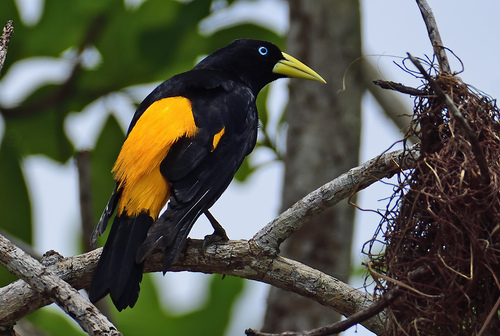
Yellow-rumped Cacique
Cacicus cela
A master of mimicry with a flash of gold, the Yellow-rumped Cacique is one of the most social and vocal birds of the tropics. Watch for their striking blue eyes and iconic hanging nests in any canopy-rich backyard.
Quick Identification
Size
Length: 23–28 cm (9–11 inches). Weight: 60–100g (2.1–3.5 oz).
Colors
Glossy black body with brilliant yellow on the rump, wing coverts, and base of the tail. Features striking pale blue eyes and an ivory-colored bill.
Key Features
- Vivid yellow rump and wing patches
- Striking pale blue irises
- Long, pointed ivory-colored bill
- Colonial nester with hanging basket-shaped nests
When You’ll See Them
Behavior
Yellow-rumped Caciques are the charismatic socialites of the tropical forest edge. Known for their incredible vocal range, these birds are master mimics, often incorporating the calls of other birds, monkeys, or even domestic animals into their complex songs. They are highly gregarious and live in noisy colonies that can include dozens of long, pendulous nests woven from plant fibers. Interestingly, they often choose to build these colonies near wasp nests, utilizing the aggressive insects as a natural security system against predatory monkeys and toucans.
In a backyard or garden setting, they are bold and inquisitive. You will often see them moving in small, active groups, fluttering through the canopy with a distinctive rustling sound created by their stiff wing feathers. While they spend much of their time high in the trees, they are not shy about descending to lower levels to investigate food sources or water baths, making them a delight for backyard observers.
EverydayEarth exclusive
Camera Tips
To capture the best footage of Yellow-rumped Caciques, height is your best friend. These birds prefer the mid-to-upper canopy, so mounting your camera 8 to 12 feet high on a tree trunk or a balcony railing will get you closer to their eye level. Angle the camera slightly downward toward a sturdy branch or a platform feeder. Because their plumage is a deep, glossy black, they can be difficult to expose correctly. Try to place your camera in an area with filtered sunlight; direct, harsh midday sun will often 'blow out' the bright yellow patches while leaving the black body as a featureless silhouette. The 'golden hour' shortly after sunrise provides the perfect soft lighting to highlight the texture of their feathers and the unique blue of their eyes.
Luring Caciques into your camera’s frame is best achieved with fruit. They are particularly fond of overripe bananas, plantains, and halved oranges. Secure the fruit to a platform feeder or spike it onto a branch within the camera's focal range. If you have a water feature, specifically a birdbath with a dripper or a small fountain, you are much more likely to capture their social interactions. They love the sound of moving water and will often visit in small groups to bathe together, offering a great opportunity for multi-subject shots.
For camera settings, prioritize a fast shutter speed or a high-frame-rate video mode. Caciques are energetic and twitchy; they rarely sit still for long, and their social displays involve a lot of wing-flicking and tail-fanning. If your AI camera has a 'bird' detection mode, ensure it is active, but also consider setting a shorter trigger interval. Since they often travel in groups, a longer recording time (20-30 seconds) will allow you to capture the 'follow-the-leader' behavior as multiple birds visit the site in succession. Lastly, don't forget the audio! Their vocalizations are half the fun, so ensure your camera's microphone is shielded from wind to record their impressive mimicry.
Similar Species
Species that look similar or are commonly confused with Yellow-rumped Cacique.
Red-rumped Cacique
Similar in shape and color, but replaces the yellow rump patch with a brilliant scarlet red one.
Crested Oropendola
Much larger bird with a chestnut-brown body, a crest on the head, and a tail that is almost entirely yellow.
Golden-winged Cacique
Lacks the bright yellow rump and has dark eyes, whereas the Yellow-rumped Cacique has a yellow rump and bright blue eyes.
Frequently Asked Questions
Record Yellow-rumped Cacique at your habitat
Connect a camera to start building your own species record — AI identifies every visitor automatically.