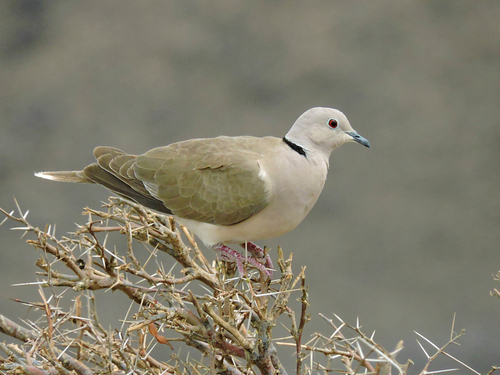
African Collared-Dove
Streptopelia roseogrisea
A resilient beauty of the Sahel, the African Collared-Dove brings a touch of desert elegance to any backyard. Recognized by its soft sandy plumage and iconic black neck ring, this social bird is a master of arid survival.
Quick Identification
Size
Length: 26–28 cm (10–11 in); Wingspan: 45–50 cm (17.7–19.7 in); Weight: 150–165 g (5.3–5.8 oz)
Colors
Soft sandy-buff to pinkish-grey body; white throat and belly; distinct black crescent collar on hindneck; dark grey primaries and white underwing coverts
Key Features
- Narrow black semi-collar on the back of the neck
- White underwing coverts visible during flight
- Dark red iris with a narrow pale eye-ring
- Pale, sandy-toned plumage compared to similar doves
- Square tail with white tips on outer feathers
When You’ll See Them
Geographic range
Where Does the African Collared-Dove Live?
The African Collared-Dove is native to the semi-arid Sahelian belt of Africa, extending from Mauritania and Senegal in the west through Sudan to Ethiopia and Eritrea in the east. Its range also stretches across the Red Sea into the southwestern Arabian Peninsula, including Saudi Arabia and Yemen. While naturally a desert-edge species, it has successfully colonized human-altered landscapes where water and grain are abundant, and is occasionally found as an introduced or escaped species in other tropical regions.
Basemap © OpenStreetMap contributors
Behavior
The African Collared-Dove is a highly social species often observed in pairs or small, loose flocks. They spend a significant portion of their day foraging on the ground, walking with a characteristic rhythmic head-bobbing motion. Despite being a bird of arid environments, they are frequent drinkers and will congregate in large numbers at water holes during the hottest parts of the day, making them a predictable visitor for patient observers.
In suburban settings, these doves are relatively bold and adapt well to human presence, often nesting in garden trees or even on building ledges. Their flight is direct and swift, featuring jerky wingbeats. They are perhaps best known for their persistent vocalizations—a rhythmic, three-syllable cooing that sounds like 'how-how-hhoo'—which they use to establish territories and attract mates throughout the year.
EverydayEarth exclusive
Camera Tips
To capture high-quality footage of the African Collared-Dove, position your camera at a low angle near a water source. In their native arid habitats, water is the ultimate magnet. A ground-level birdbath or a simple drip station will draw them in daily. Set your camera 1 to 2 feet off the ground, angled slightly upward to catch the iridescent sheen on their neck and the detail of their dark red eyes.
For baiting, use a mix of small seeds like millet or cracked corn. Because these birds forage on the ground, spreading the seed in a clear, sunlit patch will yield better results than using a hanging feeder. Ensure your camera is set to a high shutter speed or a high-frame-rate video mode; these doves are jumpy and often take flight suddenly, and a standard setting may result in a blur during takeoff.
Timing is critical. They are most active in the early morning and late afternoon when the desert heat is manageable. If you are using an AI-powered camera, set it to prioritize bird detection during these 'golden hours.' During the summer months, they will visit water sources more frequently, often arriving in small groups, which provides excellent opportunities for social interaction footage.
Avoid placing the camera in deep shade next to high-contrast sunlight, as the pale plumage of the African Collared-Dove easily 'blows out' or overexposes. Instead, look for dappled light or place the camera so the sun is behind it, illuminating the bird’s subtle pinkish-grey tones. If your camera allows, a burst mode of 3-5 photos per trigger is ideal for capturing their rhythmic head-bobbing behavior.
Similar Species
Species that look similar or are commonly confused with African Collared-Dove.
Frequently Asked Questions
Record African Collared-Dove at your habitat
Connect a camera to start building your own species record — AI identifies every visitor automatically.