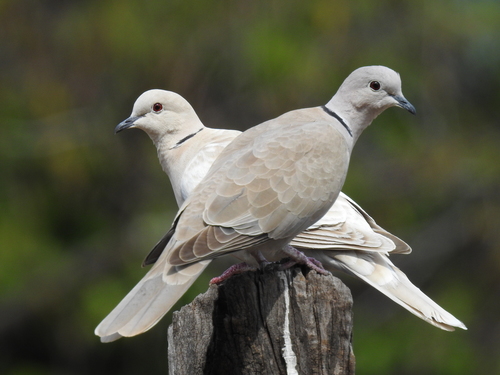
Eurasian Collared-Dove
Streptopelia decaocto
A graceful and highly adaptable visitor, the Eurasian Collared-Dove is instantly recognizable by its soothing coo and the elegant black ring around its neck. A true global traveler, this bird has become one of the most common and beloved sights in backyards around the world.
Quick Identification
Size
Length 29-33 cm (11-13 in), Wingspan 47-55 cm (18.5-21.5 in), Weight 125-240 g (4.4-8.5 oz)
Colors
Pale sandy-gray to buff overall, with a distinctive black half-collar on the back of the neck edged with white. Primaries are darker gray-brown, and the tail is gray with white outer corners. Males and females are virtually identical.
Key Features
- Narrow black half-collar on the nape of the neck
- Squared-off tail with white outer feathers
- Pale sandy-buff plumage with a slight pinkish wash on the breast
- Dark, prominent eyes with a thin white eye-ring
When You’ll See Them
Sightings on EverydayEarth
May 29, 2026
A Eurasian Collared-Dove is perched on the wooden crossbeam of a support post behind the osprey nest. The bird remains stationary for several seconds, looking around at the scenic wetland landscape and distant snow-capped mountains, before taking flight and moving out of the frame to the left.
May 28, 2026
A Eurasian Collared-Dove is perched on a branch within a large nesting structure, occasionally turning its head to scan the surroundings. A smaller bird is perched on the metal frame behind it. The platform overlooks a serene river landscape with mountains in the background under the bright morning sun.
May 27, 2026
A Eurasian Collared-Dove is perched calmly on the wooden support of an Osprey nesting platform. It occasionally turns its head to scan the surrounding wetlands and the Mission Mountains in the distance under the fading light of a cloudy evening.
May 27, 2026
A Eurasian Collared-Dove perches atop a wooden support post above an empty nesting platform. The bird is alert, frequently turning its head to survey the vast wetland and mountain landscape while letting out its rhythmic three-syllable cooing calls.
May 27, 2026
A Eurasian Collared-Dove is perched on a wooden arm extending over a nesting platform. The bird is relatively still, occasionally turning its head to scan the surrounding wetland area. The background features a calm body of water reflecting a cloudy sky and distant mountains.
May 26, 2026
A Eurasian Collared-Dove is perched atop a wooden post overlooking a large stick nest. It remains stationary for the duration of the clip, occasionally turning its head to survey the surrounding river and wetland landscape.
Geographic range
Where Does the Eurasian Collared-Dove Live?
Originally native to the warm-temperate regions of Asia and Southeast Europe, the Eurasian Collared-Dove has undergone a massive global expansion over the last century. It is now a common resident across the entirety of Europe and was introduced to the Bahamas in the 1970s, from where it rapidly spread across North America. Today, this adaptable bird can be found throughout the United States, southern Canada, Mexico, and much of Central America, thriving almost anywhere that human settlement provides a steady food source.
Basemap © OpenStreetMap contributors
Behavior
Eurasian Collared-Doves are bold and highly successful colonizers known for their distinctive three-note "coo-COO-cook" call. Unlike many shy woodland birds, they are extremely comfortable around human activity, often perching prominently on telephone wires, rooftops, and garden fences. They are frequently seen in pairs or small groups, though large flocks may gather where food is abundant, such as near grain silos or bird feeders.
During the breeding season, males perform spectacular display flights where they fly steeply upwards with loud wing-claps and then glide back down in a circular path with wings and tail feathers spread wide. They are prolific breeders and can raise up to six broods a year in warmer climates. When foraging, they walk with a characteristic head-bobbing motion, picking seeds and grains from the ground with precision.
EverydayEarth exclusive
Camera Tips
To capture high-quality footage of Eurasian Collared-Doves, focus your camera efforts on ground-level foraging spots. These birds are habitual ground-feeders, so placing your AI-powered camera on a low tripod or mounting it 12 to 18 inches off the ground near a scattering of mixed birdseed will yield the best results. Target flat, open areas of the yard where the birds feel safe from predators like hawks or cats.
Because these doves are relatively large and light-colored, they can easily trigger 'overexposure' in bright midday sun, making their features look washed out. Set your camera to prioritize early morning or late afternoon light—the 'golden hour'—which beautifully highlights the subtle pinkish tones on their breast and the stark contrast of their black neck ring. If your camera has a 'Burst' or 'Photo Series' mode, use it to capture their rapid takeoff, which often involves a loud, characteristic wing-clap.
For a different perspective, try mounting a camera near a horizontal perching spot such as a sturdy wooden fence rail or a low-hanging tree branch. Collared-doves often use these spots to survey the area before dropping down to feed. Since they are year-round residents in most areas, they provide excellent winter subjects when other migratory birds have left, especially if you provide a heated birdbath, as they require regular water for digestion.
Similar Species
Species that look similar or are commonly confused with Eurasian Collared-Dove.
Frequently Asked Questions
Record Eurasian Collared-Dove at your habitat
Connect a camera to start building your own species record — AI identifies every visitor automatically.