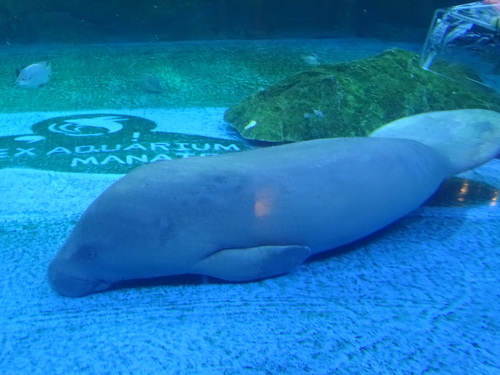
African Manatee
Trichechus senegalensis
The most elusive of the world's 'sea cows,' the African Manatee is a gentle giant of the West African waterways. These mysterious mammals navigate both salt and fresh water, hidden beneath the surface of lush mangrove forests.
Quick Identification
Size
3 to 4.5 metres (10 to 15 feet) in length; 360 to 500 kilograms (800 to 1,100 pounds)
Colors
Uniform grey to brownish-grey skin, often with a rough or wrinkled texture; may appear green or brown when coated in algae
Key Features
- Rounded, paddle-shaped tail
- Flexible, prehensile upper lip with stiff sensory whiskers
- Small, dark eyes with no external ear flaps
- Three to four fingernail-like structures on each pectoral flipper
When You’ll See Them
Geographic range
Where Does the African Manatee Live?
Native to the coastal and inland waters of Western and Central Africa, the African Manatee occupies a vast range from the Senegal River in the north down to the Cuanza River in Angola. These adaptable mammals inhabit a variety of environments across approximately 21 countries, including the massive Niger and Congo River basins. They are known to travel hundreds of miles inland where river systems allow, reaching as far as Mali, Niger, and Chad during high-water seasons.
Basemap © OpenStreetMap contributors
Behavior
The African Manatee is a shy and elusive mammal, often referred to as the most mysterious of the sirenian species. Unlike its more famous American relatives, it is predominantly nocturnal, spending much of the day resting in deep, shaded pools or hidden within thick mangrove roots. They are highly sensitive to sound and human presence, often diving at the slightest disturbance, which makes them incredibly difficult to observe in the wild.
These animals are generally solitary or found in small mother-and-calf pairs, though they may congregate in larger numbers in areas with abundant food or during the mating season. They are slow-moving creatures that glide through the water by undulating their paddle-like tails, and they must surface every few minutes to breathe, though they can stay submerged for up to 20 minutes when resting. Their social interactions involve complex vocalizations like chirps and squeaks, used primarily for communication between mothers and their young.
EverydayEarth exclusive
Camera Tips
Capturing an African Manatee on a trail camera is a challenge for even the most experienced wildlife enthusiasts. Because these animals are almost entirely aquatic and active at night, your best bet is to use a high-quality waterproof camera with 'No-Glow' infrared flash. Standard LEDs or white flashes will likely spook the manatee, causing it to avoid the area for weeks. Mount your camera on a sturdy, partially submerged mangrove trunk or a dock piling, keeping the lens about 15-20 centimeters (6-8 inches) above the water line and angled slightly downward.
Location is everything. Look for 'feeding scars' on mangrove leaves or areas where bank-side grasses have been grazed down. These animals often follow the same routes through lagoons to reach their favorite feeding spots. If you can identify a narrow channel or a calm cove with dense vegetation, place your camera there. During the rainy season, manatees move into flooded forests to reach fresh grass; this is the optimal time to set up your equipment along newly submerged banks.
Set your camera to video mode rather than still photos. A manatee surfacing for air often only shows its nostrils for a few seconds, which a still camera might miss or capture as an indistinguishable grey lump. High-definition video with audio can also capture their unique vocalizations and the distinct sound of them breaking the surface. Use a fast trigger speed (0.3s or less) to ensure you catch them as they glide through the frame. Avoid any artificial baits; instead, rely on the natural attraction of healthy, undisturbed aquatic vegetation.
Similar Species
Species that look similar or are commonly confused with African Manatee.
Dugong
Dugongs have a forked, dolphin-like tail and live exclusively in marine environments, whereas the African Manatee has a rounded tail and inhabits fresh water.
West Indian Manatee
This species is found in the Americas, grows slightly larger, and is generally more habituated to human presence than its African cousin.
Frequently Asked Questions
Record African Manatee at your habitat
Connect a camera to start building your own species record — AI identifies every visitor automatically.