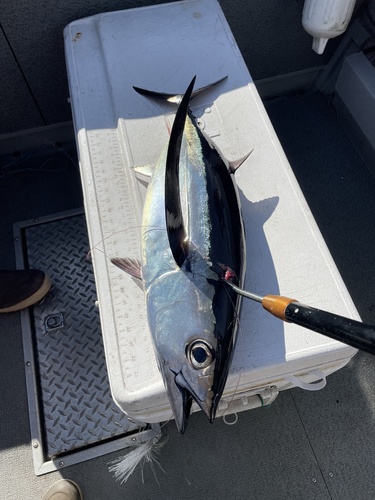
Albacore
Thunnus alalunga
The ultimate ocean wanderer, the Albacore is famous for its remarkably long fins and its tireless journeys across the world's deepest blue waters.
Quick Identification
Size
Length up to 1.4 m (4.6 ft); weight up to 60 kg (132 lbs)
Colors
Metallic dark blue on the back, shading to silvery-white on the belly; iridescent skin with a faint yellow striping possible on the sides
Key Features
- Extremely long pectoral fins extending well past the second dorsal fin
- Fusiform, torpedo-shaped body built for high-speed swimming
- Conical snout with a large mouth and large eyes
- Deep blue dorsal coloration with a sharp silvery transition
When You’ll See Them
Geographic range
Where Does the Albacore Live?
Albacore are found across the globe in temperate and tropical waters, making them a truly international species. They are native to the Atlantic, Pacific, and Indian Oceans, and maintain a significant presence in the Mediterranean Sea. From the coastal waters of the United States and Canada to the shores of Japan, Australia, and South Africa, these fish follow massive migratory routes that track shifting ocean currents and baitfish populations.
Basemap © OpenStreetMap contributors
Behavior
Albacore are the endurance athletes of the ocean, known for their incredible migratory journeys that can span entire ocean basins. Unlike most fish, they are partially endothermic, meaning they can regulate their body temperature to remain warmer than the surrounding water. This biological advantage allows them to hunt in the cold, deep layers of the mesopelagic zone during the day and return to the warmer surface waters at night.
These tuna are highly social and are almost always found in large, fast-moving schools. These schools are often organized by size and age to maintain efficient swimming speeds. While they are apex predators within their niche, they are also a vital part of the marine food web, providing a food source for larger sharks and billfish. In relation to humans, they are one of the most commercially and recreationally significant tuna species, prized for their white, mild-flavored meat.
EverydayEarth exclusive
Camera Tips
Capturing Albacore requires moving your AI camera setup from the backyard to the blue water. The best results are achieved using underwater action cameras or specialized marine rigs deployed from a boat or a drifting buoy. To catch Albacore on film, look for 'temperature breaks'—areas where warm and cool water masses meet—as these tuna use these boundaries as highways. Aim to submerge your camera between 15 and 40 feet deep, as this is the primary cruising depth for hunting schools.
Because Albacore are incredibly fast, your camera settings are critical. Use a high frame rate of at least 60 or 120 frames per second to ensure the footage isn't just a silver blur. A fast shutter speed is also necessary to capture the rapid vibration of their pectoral fins. Since the ocean can be dark, use the natural light of the midday sun to illuminate their reflective silvery bellies; position the camera so the sun is behind the lens to maximize the 'flash' of the school as they pass.
To attract Albacore into your camera's field of view, utilize 'chunking' or 'chumming' with oily baitfish like sardines or mackerel. The scent and the descending scales act as a visual lure. If you are using an AI-powered camera, ensure the housing is hydrodynamically stable; Albacore are attracted to movement, but a wobbling camera may scare them off. A 'trolled' housing that can be pulled slowly behind a vessel at 2-3 knots is often the most effective way to keep the camera stable while covering enough territory to find a school.
Similar Species
Species that look similar or are commonly confused with Albacore.
Yellowfin Tuna
Yellowfin have distinct bright yellow dorsal and anal fins and lack the extremely long pectoral fins of the Albacore.
Atlantic Bluefin Tuna
Bluefin grow much larger and have much shorter pectoral fins that do not reach the second dorsal fin.
Bigeye Tuna
Bigeye have much thicker bodies and larger eyes, with pectoral fins that are long but usually have rounded tips compared to the Albacore's.
Frequently Asked Questions
Record Albacore at your habitat
Connect a camera to start building your own species record — AI identifies every visitor automatically.