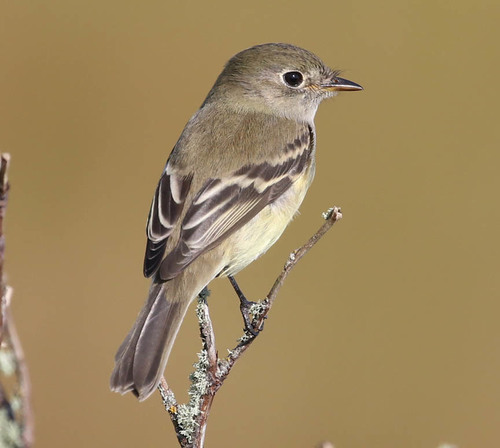
Alder Flycatcher
Empidonax alnorum
A master of the northern thickets, the Alder Flycatcher is a long-distance traveler known for its distinctive 'free-beer' song. This elusive insect-hunter thrives in the dampest corners of our continent, from Alaskan bogs to Andean foothills.
Quick Identification
Size
Length 13-15 cm (5.1-5.9 in), wingspan 18-23 cm (7.1-9.1 in), weight 12-14 g (0.4-0.5 oz)
Colors
Dull olive-green upperparts, whitish throat, pale olive wash on breast, and yellowish-white belly; two prominent white wing bars
Key Features
- Distinctive 'free-beer' song
- Thin, indistinct white eye-ring
- Slightly peaked crown profile
- Two white or buffy wing bars
When You’ll See Them
Geographic range
Where Does the Alder Flycatcher Live?
The Alder Flycatcher is a native of North America, breeding across a massive northern expanse that includes almost all of Canada, Alaska, and the northeastern United States. During the winter, these birds undertake a remarkable migration to South America, settling in the humid lowlands and Andean foothills of countries like Peru, Bolivia, and Colombia. While they pass through the central and southern United States during migration, they are rarely seen far from dense, wet vegetation.
Basemap © OpenStreetMap contributors
Behavior
The Alder Flycatcher is a quintessential "sit-and-wait" predator. It spends much of its time perched upright on exposed twigs at the edges of wet thickets, scanning the air for passing insects. When it spots prey, it performs a quick, acrobatic maneuver known as "sallying"—darting out to snap up the insect in mid-air with a click of its beak before returning to the same or a nearby perch. This species is famously cryptic and difficult to see, often remaining tucked away in dense foliage.
During the breeding season, they are highly territorial and vocal. While visually nearly identical to the Willow Flycatcher, they are easily distinguished by their raspy, three-syllable song. They are solitary birds for most of the year, though they may join loose mixed-species flocks during their long-distance migrations. Interactions with humans are rare and indirect, as they prefer soggy, mosquito-rich habitats that people typically avoid.
EverydayEarth exclusive
Camera Tips
To capture an Alder Flycatcher on an AI-powered trail camera, placement is everything. These birds are specialists of the 'edge' habitat. Look for transitions where dense, marshy shrubbery meets open water or a clear path. Mount your camera 3 to 5 feet (1 to 1.5 meters) off the ground, aiming at horizontal, exposed branches that protrude from the foliage. These are their favorite hunting perches. Use a camera with a fast trigger speed, as their sallying flight is incredibly rapid.
Since Alder Flycatchers don't visit traditional seed or suet feeders, you have to get creative to lure them into frame. A solar-powered birdbath or a simple water dripper is your best tool. The sound of moving water is an irresistible magnet for flycatchers, who use it both for drinking and bathing. Place the water source in a small clearing near dense shrubs and set your camera to capture short video clips to record their characteristic tail-flicking behavior.
Seasonality is a major factor for this species. In most of North America, they only arrive in late May and depart by late August. To ensure you don't miss them, set your camera's sensitivity to high during the early morning hours just after sunrise. This is when the males are most active singing their 'free-beer' song and defending their territory. If you have berry-producing shrubs like elderberry in your yard, consider moving your camera toward them in late July, as the birds may supplement their diet with fruit before their long flight south.
Similar Species
Species that look similar or are commonly confused with Alder Flycatcher.
Willow Flycatcher
Nearly identical in appearance; distinguished mainly by its 'fitz-bew' song and preference for slightly drier habitats.
Least Flycatcher
Smaller in size with a much more prominent, bold white eye-ring and a shorter bill.
Eastern Phoebe
Larger, lacks distinct wing bars, and has a characteristic habit of constantly wagging its tail downward.
Frequently Asked Questions
Record Alder Flycatcher at your habitat
Connect a camera to start building your own species record — AI identifies every visitor automatically.