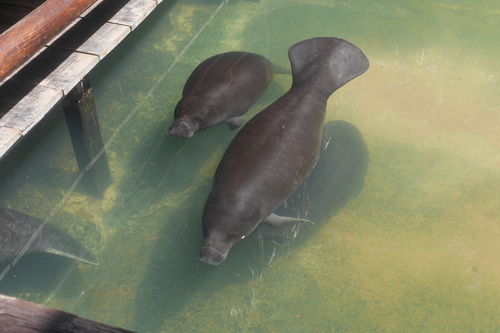
Amazonian Manatee
Trichechus inunguis
The Amazonian Manatee is the only species of its kind to live exclusively in freshwater. Known as the 'cowfish,' this gentle, nail-less giant is a master of the rainforest's hidden waterways.
Quick Identification
Size
2.1–2.8 metres (6.9–9.2 feet) in length; 300–500 kg (660–1,100 lbs)
Colors
Brownish-gray wrinkled skin with sparse fine hairs; most individuals feature a unique, irregular white or pinkish patch on the chest.
Key Features
- Distinctive white or pinkish patch on the chest
- Smooth flippers completely lacking nails
- Smallest extant manatee species
- Streamlined, torpedo-shaped body with a flat, paddle-like tail
When You’ll See Them
Geographic range
Where Does the Amazonian Manatee Live?
The Amazonian Manatee is native to the freshwater ecosystems of South America, specifically the vast Amazon River basin. Its core range spans across northern Brazil, with significant populations also found in the river systems of northeastern Peru, eastern Colombia, and eastern Ecuador. It is the only manatee species found exclusively in freshwater, never venturing into the saltwater of the Atlantic Ocean.
Basemap © OpenStreetMap contributors
Behavior
Amazonian Manatees are gentle, slow-moving mammals that spend the majority of their lives foraging for aquatic vegetation. Unlike their marine relatives, they are strictly freshwater dwellers and have adapted to the dramatic seasonal changes of the Amazon Basin. They are largely solitary creatures, though they may gather in small groups during the flood season or when congregating in deeper pools during the dry season to avoid being stranded.
These mammals are known for their quiet and shy nature, often remaining submerged for long periods and only surfacing briefly to breathe with just their nostrils visible. While they lack external ears, they have excellent hearing and use a series of high-pitched chirps and squeaks to communicate with one another, especially between mothers and their calves. Their interaction with humans has historically been one of avoidance due to centuries of hunting pressure, but in protected areas, they are becoming a focus for ecotourism and conservation education.
EverydayEarth exclusive
Camera Tips
Capturing the Amazonian Manatee requires specialized equipment, as these animals spend almost their entire lives submerged in murky river water. For the best results, use an underwater action camera or a trail camera with a high-quality waterproof housing. Mount your camera on a submerged post or heavy anchor near floating mats of aquatic vegetation like water hyacinths, which are a primary food source. Position the lens to face horizontally about 0.5 to 1 metre below the surface to catch them as they graze.
If you are setting up a camera along a riverbank or on a private dock, focus your 'backyard' setup on the water's surface. Manatees must surface to breathe every few minutes, usually exposing only their nostrils and upper snout. A camera with a fast trigger speed and high-frame-rate video capability is essential to capture these brief moments. Avoid using bright white flashes at night; instead, opt for No-Glow infrared LEDs to prevent startling these shy creatures, as they have sensitive eyes and a cautious temperament.
Seasonality is your best friend when tracking this species. During the dry season (the 'vasante'), manatees are forced into deeper permanent lakes and main river channels. This concentration makes them far easier to locate and film than during the flood season when they disperse deep into the flooded rainforest. Look for 'bubbles' or circular ripples on the surface, often called 'manatee footprints,' which indicate a submerged individual moving just below. Set your AI camera to trigger on movement at the water's edge, as they often approach the shore to reach overhanging terrestrial grasses.
Similar Species
Species that look similar or are commonly confused with Amazonian Manatee.
West Indian Manatee
Larger in size, has visible fingernails on its flippers, and lacks the bright white chest patch found on the Amazonian species.
African Manatee
Found only in West African coastal and river systems; it has a more prominent snout and lacks the Amazonian's specific white ventral markings.
Frequently Asked Questions
Record Amazonian Manatee at your habitat
Connect a camera to start building your own species record — AI identifies every visitor automatically.