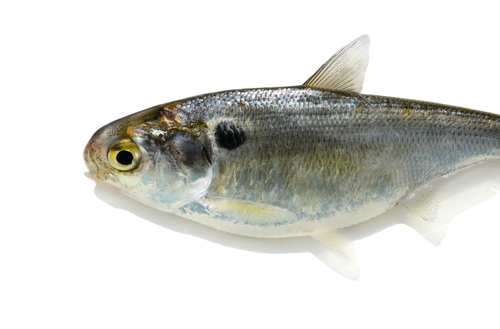
American Gizzard Shad
Dorosoma cepedianum
A shimmering cornerstone of North American waterways, the American Gizzard Shad is a master of the school. With its silver-bright scales and unique 'gizzard' stomach, this fish fuels the entire aquatic ecosystem.
Quick Identification
Size
Length: 10–20 inches (25–50 cm); Weight: 1–4 lbs (0.4–1.8 kg)
Colors
Shimmering silver-white sides with a metallic blue-green or grey back; juveniles often have a distinct dark spot behind the gills.
Key Features
- Deep, laterally compressed body shape
- Long, whip-like filament at the back of the dorsal fin
- Blunt, rounded snout with a subterminal mouth
- Sharp, saw-toothed scales (scutes) along the belly
When You’ll See Them
Geographic range
Where Does the American Gizzard Shad Live?
This resilient fish is native to the North American continent, spanning a vast territory that stretches from the Great Lakes and the Saint Lawrence River in the north down to the Gulf of Mexico. Its core range covers the majority of the eastern and central United States, reaching as far west as New Mexico and as far east as the Atlantic coast. While primarily a freshwater species, it is frequently found in brackish waters along the eastern seaboard, demonstrating a remarkable adaptability to different salinity levels.
Basemap © OpenStreetMap contributors
Behavior
The American Gizzard Shad is a highly social, schooling fish that plays a vital role in the energy cycle of North American waterways. They are most famous for their unique digestive system; like their namesake bird, they possess a thick, muscular stomach (the gizzard) that allows them to grind up organic material and sediment gathered from the bottom. This allows them to thrive in murky waters where other fish might struggle to find food.
These fish are extremely sensitive to their environment and often serve as an indicator of water quality. While they are resilient in many habitats, they are susceptible to sudden temperature drops, which can lead to large, visible die-offs in the winter. In the ecosystem, they are the ultimate forage fish, converting microscopic plankton into protein that fuels massive game fish populations like Largemouth Bass and Striped Bass.
EverydayEarth exclusive
Camera Tips
Capturing the American Gizzard Shad requires an underwater setup or a very clear view from a dock. Since these fish are highly reflective, position your camera at a slight downward angle (roughly 30 degrees) to minimize "white-out" glare from their silver scales when the sun is high. If using an external underwater housing, place the lens about 12 to 18 inches below the surface, facing a clear area of the substrate where they might forage.
To attract a school within frame, consider using "chum" or ground bait. While they are filter feeders, they are often drawn to the organic cloud created by finely ground cornmeal or breadcrumbs tossed into the water. For the best results, set your camera's trigger speed to its fastest setting; American Gizzard Shad move in quick, darting bursts, and a slow shutter will result in a silver blur rather than a crisp image.
Lighting is your biggest challenge. Early morning and late afternoon provide the best natural light for capturing the iridescent greens and blues on their backs without overexposing the silver belly. If your camera has a "burst mode," enable it—capturing 3-5 photos per trigger will increase your chances of getting a shot where the fish's long dorsal filament is clearly visible, which is their most iconic identifying feature.
Because they are schooling fish, one trigger often results in dozens of individuals in a single frame. Use a wide-angle lens to capture the scale of the school. If your camera is mounted on a pier or dock, ensure it is stabilized against wave action, as the vibration can spook the fish before they enter the frame.
Similar Species
Species that look similar or are commonly confused with American Gizzard Shad.
Threadfin Shad
Smaller with a yellowish tint on the tail and a mouth located at the very tip of the snout rather than underneath.
Alewife
Lacks the long, trailing dorsal fin filament and has a more terminal, upward-slanted mouth.
American Shad
Larger and more elongated, with a row of dark spots along the side rather than just one spot behind the gill.
Frequently Asked Questions
Record American Gizzard Shad at your habitat
Connect a camera to start building your own species record — AI identifies every visitor automatically.