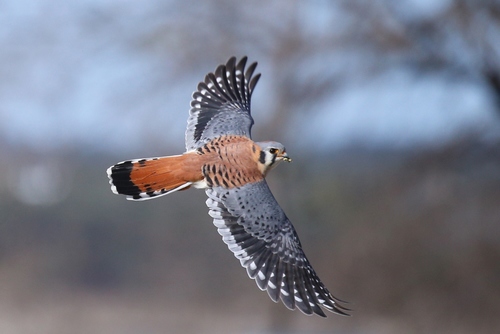
American Kestrel
Falco sparverius
North America’s smallest falcon is a colorful, high-speed hunter known for its ability to hover in place while tracking prey. With its bold facial stripes and acrobatic flight, the American Kestrel is a spectacular addition to any backyard camera gallery.
Quick Identification
Size
Length: 22-31 cm (9-12 in); Wingspan: 51-61 cm (20-24 in); Weight: 80-165 g (2.8-5.8 oz)
Colors
Males have blue-grey wings and a rufous back; females are rufous with heavy dark barring. Both have white faces with two vertical black 'mustache' stripes.
Key Features
- Two vertical black facial stripes (malar and auricular)
- Rufous back and tail with black terminal band
- Frequent tail-bobbing when perched
- Pointed wings and long tail typical of falcons
When You’ll See Them
Sightings on EverydayEarth
Jul 21, 2026
An American Kestrel is perched on a bare, sun-bleached branch of a dead tree. It remains stationary for the duration of the clip, occasionally turning its head to scan the scrubby, sun-drenched hillside below.
Jul 10, 2026
A male American Kestrel is perched on a dead, weathered branch. It is seen preening its feathers and turning its head to scan the surrounding area, likely watching for small prey or intruders.
Geographic range
Where Does the American Kestrel Live?
The American Kestrel is a truly Pan-American species, native to the Western Hemisphere with a range that spans from the subarctic tree line of Alaska and Canada all the way south to the tip of Tierra del Fuego. In North America, they are common throughout the United States and Mexico, appearing in nearly every state year-round or during migration. While northern populations move toward the southern US and Central America for the winter, many populations in South America and the temperate United States remain as permanent residents.
Basemap © OpenStreetMap contributors
Behavior
The American Kestrel is a master of the 'hover-hunt,' a specialized flight behavior where it remains stationary in mid-air by flapping its wings rapidly against the breeze. This allows the bird to keep its head perfectly still while scanning the ground for movement. Unlike many larger hawks that soar high in the sky, kestrels are perch-hunters, often seen scanning for prey from telephone wires, fence posts, or lone trees in open fields.
These falcons are highly territorial during the breeding season and are known for their vocal 'klee-klee-klee' calls. They are secondary cavity nesters, meaning they rely on existing holes in trees made by woodpeckers or man-made nesting boxes. While they are small, they are incredibly bold and will dive-bomb much larger raptors, such as Red-tailed Hawks, to drive them away from their nesting sites.
EverydayEarth exclusive
Camera Tips
To successfully capture an American Kestrel on a backyard camera, you must focus on their hunting and nesting habits. These birds are 'perch hunters,' so placing a camera on a fence post or a dedicated T-pole about 5 to 7 feet high in an open area is the most effective strategy. If you have a large property, look for a lone snag or telephone wire where they regularly sit. Position your camera about 10-12 feet away from the perch, facing away from the sun to prevent silhouette effects.
The absolute best way to get close-up, intimate footage is to install a kestrel-specific nesting box. Mount your AI camera near the entrance of the box (about 2-3 feet away) at a slight downward angle. This will allow you to capture the dramatic moments when the parents return with food for the chicks. Because kestrels are incredibly fast, set your camera to its highest possible frame rate or use a 'burst' mode. This ensures you catch the split-second of the landing or the rapid 'kiting' hover they perform just before diving.
Kestrels are visual hunters, so traditional birdseed won't work as bait. Instead, you can attract them indirectly by maintaining a 'wild' corner of your yard with taller grass, which attracts the large insects and small rodents they prey upon. Early morning and late afternoon provide the best golden-hour lighting for their colorful plumage and coincide with their peak hunting times. Ensure your PIR (motion) sensors are set to high sensitivity, as their small size may not always trigger cameras designed for larger mammals.
Similar Species
Species that look similar or are commonly confused with American Kestrel.
Frequently Asked Questions
Record American Kestrel at your habitat
Connect a camera to start building your own species record — AI identifies every visitor automatically.