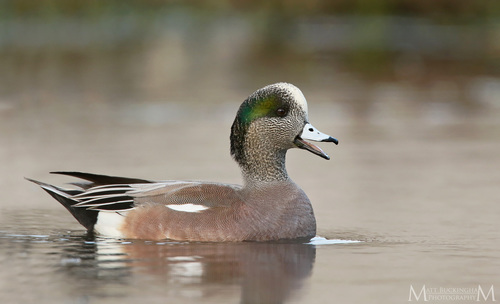
American Wigeon
Mareca americana
Known as the 'baldpate' for the male's snowy-white forehead, the American Wigeon is a vibrant and vocal dabbler. Whether grazing like a goose or whistling across a winter marsh, these ducks are a seasonal highlight for backyard pond watchers.
Quick Identification
Size
Length: 45–58 cm (18–23 in), Wingspan: 76–91 cm (30–36 in), Weight: 512–1,130 g (1.1–2.5 lbs)
Colors
Males feature a striking white crown, iridescent green eye patch, and pinkish-brown flanks. Females are a subtle mottled brown with a grayish head and dark smudge around the eye.
Key Features
- White forehead or 'baldpate' on males
- Small, pale blue bill with a distinct black tip
- Large white patches on the forewing visible during flight
- Pointed tail and white hip patches
When You’ll See Them
Geographic range
Where Does the American Wigeon Live?
The American Wigeon is a wide-ranging waterfowl native to North America, breeding extensively across the wetlands of Alaska, Western Canada, and the northwestern United States. During the winter months, they migrate in massive numbers to the southern United States, Mexico, and Central America, even reaching as far as the Caribbean islands. These ducks are highly adaptable, often appearing in suburban environments and coastal estuaries whenever freshwater inland sources freeze over.
Basemap © OpenStreetMap contributors
Behavior
American Wigeons are social and highly active dabbling ducks, often seen in large mixed-species flocks. They are famously skittish, frequently being the first ducks to take flight when a predator or human approaches a pond. Unlike many other ducks, they spend a significant amount of time grazing on land, walking through short-grass fields and meadows like miniature geese.
A unique aspect of their social behavior is their tendency to associate with diving ducks and American Coots. Because Wigeons are poor divers, they wait for these other birds to bring nutrient-rich aquatic plants to the surface and then swoop in to snatch a portion of the meal. This 'kleptoparasitism' allows them to access food sources that would otherwise be out of reach.
EverydayEarth exclusive
Camera Tips
To capture the best footage of American Wigeons, position your camera at the water's edge or near a flooded grassy patch where they are likely to graze. Because they are low-profile birds, a mounting height of 12 to 15 inches is ideal. Angle the camera slightly upward if you are placing it on the ground to ensure you catch the male's distinctive white crown and the 'baldpate' profile. Use a wide-angle lens setting if your camera supports it, as Wigeons often travel in large, spread-out groups.
Since these ducks are incredibly wary of movement, an AI-powered camera is the only way to get close-up shots without causing them to flush. Set your motion sensitivity to high and reduce the 're-trigger' delay to the minimum setting; they move quickly while grazing and you don't want to miss the interaction between individuals. Early morning light provides the best illumination for their iridescent green eye patches, so ensure your camera is positioned to avoid direct lens flare during the 'golden hour'.
If you have a backyard with a pond or a nearby wetland, you can attract them by keeping a section of the lawn short and chemical-free. They are attracted to lush, green clover and short grasses. During the winter, look for them in mixed flocks. If your camera identifies American Coots or Mallards, there is a high probability that Wigeons are nearby. Placing your camera near a popular 'haul-out' spot—a flat bank where ducks leave the water to rest—will result in excellent, steady footage of them preening.
Similar Species
Species that look similar or are commonly confused with American Wigeon.
Eurasian Wigeon
The male has a rufous-red head with a cream-colored crown, lacking the green eye patch of the American species.
Gadwall
More understated gray plumage with a black rear; lacks the white crown and green eye patch of the Wigeon.
American Coot
Not a duck, but often seen with Wigeons; it is solid black with a bright white bill and lacks the Wigeon's colorful plumage.
Frequently Asked Questions
Record American Wigeon at your habitat
Connect a camera to start building your own species record — AI identifies every visitor automatically.