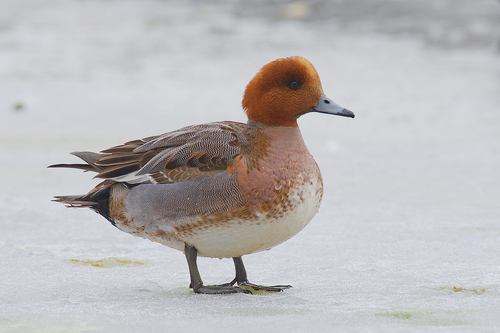
Eurasian Wigeon
Mareca penelope
With his dapper chestnut head and glowing yellow crown, the Eurasian Wigeon is the most musical guest in the winter wetland. Known for their cheerful whistling and goose-like grazing, these ducks bring a touch of wild elegance to ponds and marshes across the globe.
Quick Identification
Size
Length 42–52 cm (16.5–20.5 in), wingspan 71–85 cm (28–33 in), weight 500–1,000 g (1.1–2.2 lb)
Colors
Males feature a chestnut-red head with a distinctive creamy-yellow forehead and crown. Their bodies are mostly finely vermiculated grey with a pinkish breast and white underbelly. Females are mottled brown with a small, pale bill.
Key Features
- Male has a striking creamy-yellow 'mohawk' on a chestnut head
- Small, blunt blue-grey bill with a black tip
- Distinctive white patches on the forewing visible in flight
- Pointed black tail and white flank stripe
When You’ll See Them
Geographic range
Where Does the Eurasian Wigeon Live?
The Eurasian Wigeon is native to the vast Palearctic region, spanning from Iceland and the British Isles across Northern Europe and Russia to the Pacific coast of Asia. During the winter, these birds migrate south to reach the Mediterranean, Northern Africa, India, and Southeast Asia. While they are primarily an Old World species, small but regular numbers are spotted along both the Atlantic and Pacific coasts of North America every year, often mixing with local American Wigeon flocks.
Basemap © OpenStreetMap contributors
Behavior
Eurasian Wigeons are highly social dabbling ducks, often seen in large, vocal flocks during the winter months. Unlike many other ducks that spend most of their time filtering water, wigeons are skilled grazers. They can frequently be found on land, nibbling on short grass in wet meadows or salt marshes, mimicking the behavior of geese. Their presence is often announced by the male's loud, musical whistle—a sharp 'pjiew-pjiew'—which is much more common than the typical duck quack.
These birds are known for their somewhat 'nervous' disposition compared to Mallards, often being the first to take flight when disturbed. In suburban settings, they may become accustomed to humans if they inhabit park ponds or golf course water hazards, but they generally prefer open spaces where they have a clear view of potential predators. During the night, they may move from their daytime roosting waters to nearby fields to feed under the cover of darkness.
EverydayEarth exclusive
Camera Tips
To capture high-quality footage of the Eurasian Wigeon, place your camera at the water's edge where the shore meets short grass. Because these ducks love to graze, a camera mounted low to the ground (about 6-12 inches high) and angled slightly upward will provide an intimate, eye-level perspective of their unique feeding behavior. If you are monitoring a backyard pond, position the camera near the shallowest entry point where they are likely to walk out onto the bank.
While we don't recommend heavy baiting in wild wetlands, in a controlled backyard setting, a small scatter of mixed grains or specialized waterfowl pellets can encourage them to linger in front of the lens. These ducks are highly communal, so use a wide-angle lens setting if your camera allows; this ensures you capture the interaction of the whole flock rather than just a single bird. They are particularly active and vocal at dawn, so ensure your camera is set to its highest sensitivity during these early morning hours.
Since wigeons are often active at night, especially during a full moon, a camera with 'No-Glow' infrared technology is essential. Standard 'Low-Glow' LEDs can sometimes startle these skittish birds. For the best action shots, use a high frame rate (60fps) to capture the beautiful white wing patches and the distinctive 'whistling' head-toss displays males perform during the late winter months as they begin pair-bonding.
Similar Species
Species that look similar or are commonly confused with Eurasian Wigeon.
Frequently Asked Questions
Record Eurasian Wigeon at your habitat
Connect a camera to start building your own species record — AI identifies every visitor automatically.