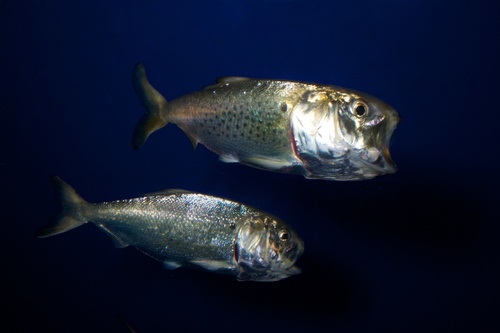
Atlantic Menhaden
Brevoortia tyrannus
Known as the silver foundation of the Atlantic ecosystem, these shimmering filter feeders travel in massive, mesmerizing schools that sustain entire coastal food webs.
Quick Identification
Size
12-15 inches (30-38 cm) in length; weighs up to 1.1 lbs (0.5 kg)
Colors
Silvery-blue or greenish back with bright silver and brassy sides; distinct dark spot behind the gill cover
Key Features
- Large scaleless head and deeply notched upper jaw
- Distinctive dark 'shoulder' spot followed by smaller, lighter spots
- Deeply forked tail and iridescent silver scales
- Deep, laterally compressed body shape
When You’ll See Them
Geographic range
Where Does the Atlantic Menhaden Live?
The Atlantic Menhaden is native to the western Atlantic Ocean along the coast of North America. Its range stretches from the cold waters of Nova Scotia, Canada, southward to the subtropical reaches of Northern Florida. They are most abundant in the Mid-Atlantic region, particularly within the Chesapeake Bay and the various sounds and estuaries of the Eastern Seaboard, where they migrate into shallower waters during the warmer months.
Basemap © OpenStreetMap contributors
Behavior
Atlantic Menhaden are famous for their highly disciplined schooling behavior, often congregating in massive groups that can number in the millions. These schools, sometimes called 'pods,' move in near-perfect synchronicity, creating shimmering silver clouds in the water that help protect individuals from predators. They are obligate filter feeders, meaning they spend much of their time swimming with their mouths agape, filtering massive quantities of water to extract microscopic nutrients.
Often referred to as 'the most important fish in the sea,' Menhaden play a critical role in the coastal food web. They act as a biological bridge, converting the energy of plankton into fat-rich protein for larger predators like striped bass, bluefish, dolphins, and humpback whales. While they are not typically a target for recreational anglers to eat, they are the foundation of a massive commercial reduction fishery for oil and fishmeal.
EverydayEarth exclusive
Camera Tips
Capturing Atlantic Menhaden on camera requires an underwater setup or a specialized aerial perspective. If you live on the water, the most effective method is to mount a waterproof action camera to a dock piling or a submerged weighted PVC frame. Set the camera about 2 to 5 feet below the surface facing outward toward open water. Because these fish move in such tight, fast-moving schools, a wide-angle lens is essential to capture the full scale of the 'pod' as it passes by.
For those filming from above the water, such as from a pier or backyard deck, a circular polarizing filter is your most important tool. Without it, surface glare will hide the fish; with it, you can see the dark 'nutmeg' color of the school and the silver flashes of their scales. The best time for surface filming is when the sun is at a 45-degree angle—early morning or late afternoon—to maximize the shimmer of their scales as they break the surface or 'flip' in the water.
If you want to draw a school into your camera's field of view, consider using a fine-mesh chum bag filled with menhaden milk or ground fish meal suspended near the lens. While they don't strike at solid bait, the scent of concentrated nutrients can stall a passing school in front of your camera. At night, using a green or white underwater light can be highly effective; the light attracts the zooplankton that Menhaden feed on, which can lead to incredible footage of the fish 'ram-feeding' through the illuminated water.
Set your camera to a high frame rate, at least 60 or 120 frames per second. Menhaden are incredibly fast, and their silver scales can cause 'blown-out' highlights in bright sun. Lowering your exposure compensation by -0.5 or -1.0 can help preserve the iridescent detail on their sides. If using a trail camera near the water's edge, look for areas where predatory birds like ospreys are diving, as this is a surefire sign that a school is within range.
Similar Species
Species that look similar or are commonly confused with Atlantic Menhaden.
Gulf Menhaden
Nearly identical in appearance but found exclusively in the Gulf of Mexico rather than the Atlantic coast.
Atlantic Herring
Lacks the dark spots behind the gills and has a more elongated, less deep body shape.
American Shad
Grows much larger and has a more distinct row of dark spots that fade toward the tail.
Frequently Asked Questions
Record Atlantic Menhaden at your habitat
Connect a camera to start building your own species record — AI identifies every visitor automatically.