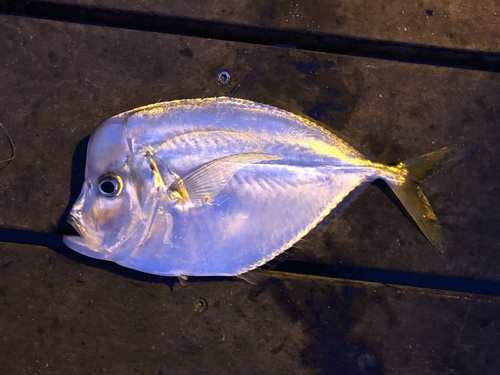
Atlantic Moonfish
Selene setapinnis
A master of optical illusion, the Atlantic Moonfish uses its mirror-like skin and razor-thin body to vanish in the sunlit shallows of the Atlantic coast.
Quick Identification
Size
Typically ranges from 23 to 30 cm (9 to 12 inches) in length, with a maximum recorded length of 48 cm (19 inches). They usually weigh less than 1 kg (2.2 lbs).
Colors
Uniformly metallic silver with a brilliant pearlescent or iridescent sheen; occasionally displays a faint yellowish tint on the fins.
Key Features
- Extremely thin, pancake-like body shape
- Blunt, steep head profile with a high forehead
- Very short pelvic fins and a deeply forked tail
- Mirror-like, scale-less appearance
When You’ll See Them
Geographic range
Where Does the Atlantic Moonfish Live?
The Atlantic Moonfish is native to the western Atlantic Ocean, thriving in the coastal waters of the Americas. Its range extends from the northern reaches of Nova Scotia, Canada, southward through the Gulf of Mexico and the Caribbean Sea, reaching as far south as the coast of Uruguay and northern Argentina. It is most commonly encountered in the warm-temperate and tropical waters of the Mid-Atlantic United States and the Brazilian coast, where it stays relatively close to the continental shelf.
Basemap © OpenStreetMap contributors
Behavior
The Atlantic Moonfish is a highly social, schooling species that relies on its unique anatomy for survival. Its body is so laterally compressed that when viewed head-on, the fish almost disappears, a form of camouflage known as transparency through thinness. This allows them to hide in plain sight from larger predators like sharks and jacks in the open water column.
These fish are active swimmers and are often seen patrolling the middle depths of coastal waters. While they are generally shy around humans, they are curious about light reflections and may approach stationary objects. They do not maintain territories but move fluidly in groups to coordinate feeding and defense. Unlike some of their more aggressive relatives in the Carangidae family, Moonfish are relatively peaceful and primarily focus on hunting small, soft-bodied prey.
EverydayEarth exclusive
Camera Tips
To successfully capture the Atlantic Moonfish on an AI-powered underwater camera, placement is the most critical factor. These fish prefer the mid-water column in shallow coastal areas, so mounting your camera to a dock piling or a submerged reef structure at a depth of 2 to 5 meters (6 to 15 feet) is ideal. Because of their mirror-like skin, angling the camera slightly downward—away from the direct glare of the sun—will prevent 'white-out' reflections that can confuse AI identification algorithms.
Using a bait lure or a 'chum' dispenser is highly recommended to bring these schooling fish into the camera's field of view. A mesh bag filled with crushed oily fish or shrimp will attract the smaller baitfish that Moonfish hunt. Once a school finds a food source, they tend to linger and circle the area, providing the AI with multiple angles of their distinctive disc-shaped profile. Avoid using high-intensity white LEDs at night, as the reflection off their silver bodies can overexpose the image; instead, use low-glow infrared (IR) for nocturnal activity.
Seasonal timing significantly impacts your success rate if you are outside of the tropics. In the Mid-Atlantic and Northeast U.S., wait for the late summer months when water temperatures are at their highest and the fish move closer to shore into bays and estuaries. During these times, look for 'slick' water days with high visibility. Setting your camera's trigger sensitivity to high is beneficial, as the Moonfish's thin profile may not always trigger motion sensors when swimming directly toward the lens.
Similar Species
Species that look similar or are commonly confused with Atlantic Moonfish.
Lookdown
The Lookdown has extremely long, trailing filaments on its dorsal and anal fins, whereas the Moonfish has very short, inconspicuous fins.
Atlantic Bumper
The Bumper has a more traditional elongated fish shape and a distinct black spot on the base of its tail, unlike the disc-shaped Moonfish.
African Moonfish
Nearly identical but found only along the eastern Atlantic coast of Africa; separated by geographic range.
Frequently Asked Questions
Record Atlantic Moonfish at your habitat
Connect a camera to start building your own species record — AI identifies every visitor automatically.